인류 역사는 대규모의 기만사(欺瞞史)
기만해 왔고 기만 당해
온 역사다. 악령 용 사탄이 인간을 지배하여 기만했고 인류는
기만 당해 온 것이다. 지금은 하나님이 존재한다고 열을
올리고 또 그러하겠지만(이유는 자기 스스로가 창조자로
가장하여 등장하려니까), 지금까지는(악령의 그와 같은 시도를
막는 자가 있어 이제까지 막혀 있었기에) 하나님이 없다고
온 세상을 하나같이 속여 온 것이다. 자연계에 속한 우리
인간은, 초자연계에 속해 초능력을 행사하는 악령의 적수가
아니다.
일방적으로 당하도록만
되어 있다. 오직 진리를 찾아 두드리고 구한 자에 한해서
하나님의 지시를 받들어 거룩한 천사(악령들과 같은 수준의
영물 즉 초자연계 존재로서 악을 행하므로 악령이라 하고
천사는 공동체 의식에 충실했으므로 "거룩하다" 함이니
같은 사람이면서도 악하면 악인이라, 선하면 의인이라 함과
같은 것)들이 활동해 온 것이다. 그리고 이렇게 당하고
있어도 당한다는 사실조차 몰랐다. 그래서 성경은 우리 인생들이
어두움에 사로잡혔다 하고 눈이 감겨져 있다 하고 사탄의
세력 아래 있다고 한 것이다(행 26:18/고후 4:4).
고로 이 세상 지배자의
정체를 알 리가 없다. 그래서 속이는 대로 그냥 속을 수밖에
없었고 그렇게 해서 지금까지 지내 온 비극의 역사다. 무신론이
그렇고 진화론이 그렇고 세상 종교가 그렇다. 진화론은 자연계
관찰 그것만으로 족하다. 훌륭한 업적이다. 그 관찰한 결과에다
어쭙잖게 전혀 답지 않게 무신론을 갖다 붙여 성경(하나님의
말씀으로서의)을 부정하려는 데에서 문제가 생기는 것이다.
인간이든 만물이든 모두 만들어 완성시키신 것이라 결론을
내리는 성경에 반기를 들어 진화했다고 하니까, 또는
완결된 창조를 "진화를 통한 창조"라는 궤변을
토하니까 말썽일 수밖에 없다.
불교 등 세상 종교도
똑같은 오류에다 그런 "도를 넘어섬"까지 보탠
결과물이다. 이 자연계만 인식하는 즉 동전의 일면만
보는 무식에서 출발했기 때문이다. 초자연계에서는
덧없다(無常)는 것이 없다. 항구여일이다. 상주(常住)다. 이
상주를 이루고 있는 '이 세계와 대립되어 있는 세계' 곧
초자연계를 간과한 것이다. 이런 미망을 깨우치는 것이 3위1체의
원리다. 반드시 대칭을 이루고 있는 또 하나의 세계를 인식하지
않으면 안되는 것이다. 고로 지금부터는 인간의 진화를 말하는
진화론은 물론 불교의 교리도 헌신짝처럼 내다 버릴 때이다.
천주교는 어떤가. 마리아를
친근히 하여 신격화하고 있다는 것이 결정적 흠이다. 이 마리아의
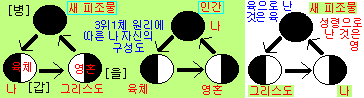
존재는 아무 쓸모가 없다. 인간과 그리스도와의 관계는 '머리와
몸', '영혼과 육체' 관계로서의 대칭 관계를 따르는 것으로서
둘이 하나로 작용하기 때문에 가능해지는 구원이기 때문이다.
그리스도 이상으로 가까운 인간 관계가 없다. 부모 아내/남편/자식보다도
더 가깝다. 나 자신보다 더 가까우시니 왜냐면 나는 나 자신을
위하지는 않아도 그리스도는 위하게 되어 있는 영원 삶의
구조이기 때문이다.
이 구조는 창조 당시부터
변함이 없다. 그리스도께서 등장하심으로 된 것이 아니다.
원래 이러한 생명의 구조였는데 범죄로써 이탈해 있었지만
이제는 그리스도로 말미암아 회복되었다는 의미다. 곧 구속(救贖,
redemption)의 의미다. 우리는 죄인으로서 죽어 마땅하기 때문에
그 마땅한 우리의 죽음에 동참하시어 이 '둘로서의 하나'를
이루심이 십자가 공로요 따라서 그 피 흘리심으로 우리의
모든 죄가 용서되는 유일의 근거다.
나와 하나가 되셨기 때문에
문자 그대로 성령으로 임하시어 내 안에 상주(常住)하심이다.
하나님의 아들 친히 내 안에 계시어 나와 하나되셨으니 그
이상 바랄 것도 보탤 것도 없다. 그런데 웬 마리아냐 하는
것이다. 그리스도 친히 그리고 하나님의 아들이신 그리스도를
통해 아버지 친히 내 안에 계심이다(요이 1:9). 하나님 친히
내 안에 계시는데 인간 마리아가 무슨 의미가 있고 소용이더라는
말인가. 마리아를 숭상한다는 것은 방금 설명한 것과 같은
구원의 이치를 전혀 알지 못한다는 증거다. 그러므로 성경의
위치에서 보면 사이비다. 이런 사이비는 버리면 버릴수록
덕이다. 붙들고 있으면 있을수록 구원과는 멀어진다. 불교도가
불교의 교리를 떠나 성경으로 돌아와야 하듯이 천주교인도
천주교를 버리고 성경으로 돌아올 일이다.
개신교도 마찬가지다.
왜냐면 사람 삶의 도리를 모른다는 점에서는 일반이기 때문이다.
"자기 부인"과 "매일 십자가 짐"을 설교 강단에서
가르치지 않는 것이 그 증거다. "항상 복종하여 두렵고
떨림으로 너희 자신의 구원을 이루라"는 경고를 납득
못해서 설교 강단에서 이 주제로 교인들에게 경고하지 않았다는
것이 그 증거다. 사안의 심각성은 천주교가 마리아를 버리지
못함과 똑같다. "항상 복종함으로써 두렵고 떨림으로
각자의 구원을 이룸"을 무시함은 작대기 하나가 있으면
이 끝만 강조하고 저 끝을 인정하지 않음과 같은 무리인데도
이를 인식 못한다. 성경에 분명히 가르치고 있는데도 이를
외면하고 심지어는 알려고도 않는다.
작대기 이 끝만 본다는
것은, 그리스도의 구원만 다시 말해 우리 위하신 사랑만 인식한다는
뜻이다. 이는 일방적인 것이요 '대칭적인' 의미가 아니니,
상대가 사랑하면 나도 사랑하는 것이 '둘로서의 하나'가 되는
의미다. 작대기의 이 끝과 저 끝을 동시에 인식해야 하나의
작대기라는 의미가 형성된다. "나 자신의 구원을 이룬다"는
것은 내가 그리스도를 사랑하고 위한다는 사랑의 언어요
어법(語法)이다. 그런데도 개신교는 이를 완전히 무시하고
가르치지 않는다. "하나님의 은혜" 일변도다. 계속
강조하지만 작대기의 저 끝만 인식한다. 그리고서는 구원이
완성된 것인 양 자기를 기만한다. 이것이 전반적으로
개신교의 허구성이다. 물론 그렇지 않은 데도 있다. 그러나
너무 미미하여 그 존재를 알지 못할 정도거나 철저히 무시
배제되어 왔다.
물론 구원은 완성된 것이다.
내가 나 자신의 구원을 위해 한 손가락도 움직일 필요가
없다. 하나님의 창조로 내가 세상에 존재하게 될 때 내 스스로
무엇을 개입한 적이 없음과 같다. 그래서 우리의 구원을
가리켜 새 창조라 한다. 다시 출생함이라 말함도 같은
뜻이다. 내가 나고 싶어서 난 것이 아니다. 즉 나라는 요소는
일절 개입하지 않았다. 우리의 구원 곧 새로 창조됨, 다시
출생함이 이와 같다. 문제는 이렇게 창조되었으면 즉 살게
하셨으면 마땅히 살아야 하는 방법대로 살아야지 이 법을
무시하고 내 욕심만 채우려고 타인을 불행하게 만들 때 그것은
사는 것이 아니라 그 반대인 죽음이라는 뜻이다. 그래서 그
죄 값(첫 사람 아담이 지은)으로 우리가 지금 이와 같은 불행
속에 처해 있는 것이다.
그러므로 성경에 대해
무식하기는 개신교도 불교도나 천주교도와 똑같다. 유신론자라고
구원 얻는 것이 아니고 예수 그리스도를 믿는다고 소위 "신앙고백"을
한다고 영생하는 것이 아니다. 속이는 자 악령 사탄이 만들어
놓은 거짓 것을 더 믿어 이상 설명과 같이 성경의 가르침대로
따르지 않으니까 속임수에 넘어가 멸망의 길을 걷는 것이다.
그런데도 구원 받은 것이라고 자신도 속이고 남도 속이고
그렇게 가르쳐 온 것이다.
불교도나 기독교도나
무신론자나 똑같이 내려지는 하나님의 명령은 "회개하라,
뉘우쳐라, 회심하라, 돌이켜라"(행 17:30)이다. 영원한 이상향은
회개하는 자만이 들어가는 데다. 그래서 회개하라, 천국이
가까웠다고 외치신 것이다(마 4:17). 무엇을 뉘우치느냐, 지금까지
삶의 법대로 살지 못했음을 버리는 것이요 삶의 법대로
살기로 작정하는 것이다. 즉 3위1체의 원리에 나타난 대로의
'둘의 하나됨'을 따라야 진정 사는 것이다. 작대기 하나를
온전히 인식하려면 이 끝과 동시에 저 끝도 함께 보는
것이니 즉 내게 대한 하나님의 사랑을 확인했으면 나도
하나님을 사랑함이 필연 필수이다.
이와 같이 서로 사랑함에서
자기 부인이 나타나는 것이고 매일 십자가 짐이 실천
가능해지는 것이요 항상 복종하여 두렵고 떨림으로 나
자신의 구원을 이룸이 된다. 마땅히 살아야 할 '사는 법'대로
내 스스로 사는 것이 나의 구원을 이룸이다. 죽은 나를
살리셨으니 그 산 자답게 나를 산 자로 만들어 주신 그 뜻에
합당하게 머리와 몸의 관계에서 몸(의 각 지체 각 부분)으로서의
본부를 다함이, 바로 "나 자신의 구원을 이룸"이다.
갑은 을을 위하고 을은 갑을 위함이 되도록 그래서 둘이 하나되도록
나를 산 자로 살리셨으니 작대기의 이 끝이 있으니 저 끝이
있어야 하겠기에 그 이 끝 혹은 저 끝으로서의 본무를 다함이
재차 강조하거니와 "나 자신의 구원을 이룸"이다.
너무나 속아 온 것이다.
그래서 사탄이 이 세상 지배자라 해도 의아해하고 그가
용(龍, dragon)이라 해도 어리둥절해하는 정도다. 성경에 대한
무지가 이 정도다. 성경이 어려워서가 아니라 강제로 눈이
감겨져 보지를 못하기 때문이다. 아무리 "낫 놓고
기역자"라도 눈이 감겨져 있으니 모를 것이야 뻔하다.
머리가 둔해 모르는 것이 아니라 타의에 의해서 강제로 보지
못하기 때문에 모르는 것이다. 성경에 그토록 두 번씩이나
강조해서 사탄이 창세기에 나오는 그 "뱀"(우리가
현재는 자연계에 속해 있으므로 자연계를 기준하여 서술하다보니까)
곧 용(초자연계에서의 그 대칭되는 모습)임을 설명했건만(계
12:9/20:2) 지금까지 마이동풍으로 지내 왔기 때문이다.
그동안 너무나 딴판인
것으로 세뇌당해 왔던 것이다. 속아 오기가 이 정도다. 아무
것도 아닌 일이건만 속아 온 것이다. 낫 놓고 기역 자도 모른다는
말이 이에 해당된다. 인식만 하면 되건마는 눈이 감겨져 있으니
보지를 못한다. 강압적으로 눈을 감겨놓으니 이런 것이다.
뒤로 손을 묶어 꼼짝 못하게 해놓고 안대로 싸매 놓으니 천하
없어도 볼 수가 없고 볼 수가 없으니 도리가 없으며 무지몽매한
사람처럼 되는 것이다. 이러한 속이는 자의 실상을 알라는
것이다. 속고 있음을 뒤늦게나마 지금이라도 늦지 않으니
각성하라는 것이다.
위험을 알려주는데도
듣지 않으면 그만이다. 바울 사도는 "내가 모든 것을 꺼림
없이 전달하여 주었으니 모든 사람의 피에 대하여 내가 깨끗하다"(행
20:26)는 무서운 말을 했다. "무섭다"는 것은, "칼이
임함을 보고도 파수꾼이 나팔을 불지 아니하여 백성에게
경고치 않음으로써 그 중에 한 사람이 그 임하는 칼에 제함을
당하면 그는 자기 죄악 중에서 제한 바 되려니와 그 죄를
내가 그 파수꾼의 손에서 찾을 것이다. 인자야, 내가 너로
이스라엘 족속의 파수꾼을 삼음이 이와 같다.
"그런즉 너는 내 입의
말을 듣고 나를 대신하여 그들에게 경고하라. 가령 내가 악인에게
이르기를 악인아 너는 정녕 죽으리라 하였다 하자 네가 그
악인에게 말로 경고하여 그 길에서 떠나게 아니하면 그 악인은
자기 죄악 중에서 죽으려니와 내가 그 피를 네 손에서 찾을
것이다. 그러나 네가 악인에게 경고하여 돌이켜 그 길에서
떠나라고 하되 그가 돌이킴으로 그 길에서 떠나지 않는 경우
그는 자기 죄악 중에서 죽으려니와 너는 네 생명을 보전할
것이다..
"나의 삶을 두고 맹세하거니와
나는 악인의 죽는 것을 기뻐하지 않고 악인이 그 길에서 돌이켜
떠나서 사는 것을 기뻐한다. 이스라엘 족속아, 돌이키고 돌이키라.
너희 악한 길에서 떠나라. 어찌 죽고자 하느냐 하셨다 하라"(겔
33:6-11)는 경고가 오늘날 진리를 안다고 하는 모든 이들에게
임하여 있음을 아는 까닭이다. 살인죄만 처벌 대상이 아니라
살인 방조죄도 있다. 성경은 이 둘을 똑같이 취급하는 것이다.
본질이 같기 때문이다.
"두 세 사람이 내
이름으로 모이는 곳에는 내가 거기 함께 있다"(마 18:20)
하셨다. 이 세상이 그리스도의 나라가 아니고 악령 사탄의
지배 아래 있으므로 세상 종교처럼 버젓이 전당을 지어놓고
있을 짬도 겨를도 여유도 없다. 언제 핍박이 닥칠지 모르는
일이므로 그렇다. 뿐 아니라 그리스도를 믿는 믿음은 올바른
삶에 있으므로 모인다는 것 자체에 의미를 두지 않음이다.
모이는 목적이 중요한 것이다. 서로를 격려하기 위한 필요에
의해서(히 10:25/3:13) 모이는 것이요 이 필요는 주님 다시 오실
때까지 지속될 수밖에 없는 성격이다.
그러므로 초대 교회는
매일 모였다. 필요하니까 매일 모인 것이다. 성전 개념은
그리스도 이후에는 성령을 모신 각 사람의 몸으로 되어 있다.
"이 성전을 헐라, 내가 사흘 동안에 다시 일으킬 것이다"(요
2:19-21) 하고 선언하신 것으로 이미 기정 사실화되었다. 건물을
하나님의 성전으로 착각하지 말 것이다. 이는 상식적으로도
통하지 않는다. 정부 당국이 교회 건물을 파괴 또는 폐기시켰을
때 그러면 인간이 감히 하나님의 집을 손댔으니 하나님보다
더 강하다는 뜻이라는 말인가.
하나님의 전이셨던 그리스도의
몸이 십자가에 못박히고 우리가 하나님의 전인데도 온갖
악형으로 망가지는 것은 별문제다. 구원해내야 할 상대의
고난에 함께 함으로써 한 몸으로서의 '둘이 하나됨'의
진리대로 됨이기에 그렇다. 그러나 건물은 그런 의미가 전혀
없다. 이로 보아서도 이상 사실은 명백해진다. 고로 지금
극심한 핍박이 자행되고 있는 북한 사회라 여기고 그 사회에
우리가 처해 있다고 생각하고 교회 활동을 하면 그것이 정상적이다.
그것이 성경의 표준이다.
가장 바람직한 것은 교역자가
성경대로 깨닫고 올바르게 가르치는 일이다. 교역자가 그렇지
못하면 그렇게 되도록 그 영혼을 위해 기도해주는 일이다.
절의 승려든 성당의 신부든 진리를 깨달은 대로 자기 신도들에게
전할 일이요 건물을 가지고 다툴 필요는 없다. 비교적 이런
면에서 자유로운 개신교 교회당도 마찬가지다. 교역자가
성경대로 가르침에도 불구하고 교인들이 수용하려 들지 않는다면
거기서 편 갈라 다툴 이유가 없다.
뜻을 같이 하는 사람들과
함께 거기서 나오면 되는 일이다. 중국에서 그런 가정 교회
또는 집 교회로 시작하여 하나님의 사업을 하고 있는 예가
과거에도 많았고 지금도 그렇다. 세상 종교는 원래 하나님이
계시지 않는 곳이니까 겉 치장이나 요란하게 할 필요가 있을
것이다. 그러나 성령을 모신 이들은 다른 것이다.
2016년 4월 6일 수요일

2016년 4월 4일 월요일
모든 허구와 거짓을 짓밟아 뭉개버리는, 인류가 일찍 구경 못한 초대형급 거물(巨物)ㅡ3위1체의 원리와 인간 생애의 법칙 (보완)
모든 허구와 거짓을 짓밟아 뭉개버리는, 인류가 일찍 구경 못한 초대형급 거물(巨物)ㅡ3위1체의 원리와 인간 생애의 법칙이 소용돌이 치며 스쳐 지나간 다음에는, 적 그리스도가 인류 역사상 일찌기 구경 못한 기적(초능력)의 최대 장관을 이루면서 무대에 설 것이고, 그 다음에는 우리 인류의 대표이신 마지막 아담 곧 예수 그리스도께서 마침내 등장하시는 클라이맥스가 전개될 전망이다. "허구"라 "거짓"이라 한 것은, 이 세상의 지배자 악령이 단순히 보이지 않는다는 이유로 "창조자 하나님은 없다"고 선전해 온 순도 100프로의 속임수를 가리킴이다. 한심한 것은 또 그렇다고 거기 넘어간 인생들이다. 더군다나 "배웠다"고 하는 이른바 지식인층이다. 그러므로 앞으로 "과학적 지식"을 가지고 성경과 어긋나는 것으로 접근해올 때, 그것이 무엇이든 간에 일언지하로 퇴짜를 놓고 무시해버리는 것이 지금까지 오면서 얻은 학습 효과이니 이에 유의할 일이다.
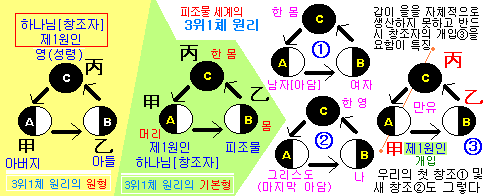
인간 생애를 주장 주관하고 있는 법칙(3운법칙, trini homo, fas homo, fashomo)이 알려졌는데, 이 이상으로 더 중요한 것이 우리 삶에 있을 수 없다. 이 법칙은 3위1체 원리의 지배를 받는다. 그래서 3위1체의 도식 그대로를 반영하고 있는 특이한 구조를 하고 있어 이것이 3위1체 법칙을 검증한다고 하는 것이다. 또 이러한 이유 때문에 3위1체의 원리는 3운법칙의 확실성과 진실성을 보증, 보장하는 것이다. 그래서 상호 검증이다. 자연계 법칙에만 한정되는 자연과학의 모든 법칙과 원리도 이 3위1체의 원리의 지배하에 있다.
이 3위1체의 원리는 지금까지의 모든 자연법칙에 새로운 조명을 시켜주고 있다. 즉 예를 들어 빛의 파동성과 입자성은 모자(母子, 파생시킴과 파생됨) 관계에 있다는 전혀 새로운 사실을 밝혀 주고 있는 것이다. 다시 말해 둘은 주종(主從), 인과(因果) 관계에 있다는 것이다. 이 사실을 전제로 하여 둘 사이를 규명해 나가야 하는 것. 그리고 "양자 얽힘"에서 'down 스핀'과 'up 스핀'의 정반대되는 성질의 반응을 보이는 x미립자와 y미립자의 양자 관계(짝을 이룬) 역시 같은 모자 관계 즉 주종, 인과 관계를 이루고 있음을 3위1체의 원리는 천명한다. 그것이 어떤 결과와 영향을 미치는지는 해당 분야의 전문가인 물리학자들의 몫이다.
(그리고 부언하는 것은, 지금부터는 homo sapiens science 즉 "인간학"이라는 새로운 분야의 학문이 개설됨으로써 자연계와 초자연계를 아울러 연구하는 계기를 이룸이 되지 않을까 하기도 하지만ㅡ. 인간 생체에 대해서는 생물학의 전담 분야이고 초자연계까지 포함하는 것으로서 유일한 연구 건목이 될 만도 하지만ㅡ. 그러나 그런 학문으로서의 여유마저 허락하지 않을 것은 지금 때가 너무나 절박하기 때문이다. 다니엘이 예언한 바 지식의 급증(단 12:4)과 더불어 지금은 머리가 핑핑 돌 정도로 모든 것이 급속도로 변화하여 전개되고 있음이다. 악령이 창조주로 가장하여 온갖 초능력을 구사하면서 등장하기가 무섭게 곧이어 마지막 아담께서 그 모든 초자연계 몸의 초능력으로 세상에 다시 임하셔서 그 현란한 자태를 드러내실 것이니, 연구하고 말고도 없이 곧장 모든 것은 실제 상황으로 직진, 돌입하기 때문이다.)
모든 분야에서 무릇 대칭을 이루고 있는 형상, 현상은 반드시 이러한 모자 관계에 있음을 아는 것이 중요하다. 대등한 것은 아무 것도 없다. 대등한 것이라면 이렇게 일사불란하게 우주가 운행될 수가 없다. 하나로서의 둘, 둘로서의 하나다. 그렇기 때문에 탄탄한 구조를 이루어 지금까지 한 치 오차 없이 진행해 나가고 있는 것이다. 물론 이런 상태가 아무 변동, 변화 없이 지속된다는 말은 아니다. 3운법칙과 3위1체 원리의 모태(母胎)요 산실(産室)이자 모든(자연계와 초자연계를 아우르는) 과학의 총본산인 성경이 이 우주는 헌 옷처럼 되어 장차 새 옷을 갈아입게 된다고 밝히고 있기 때문이다.
기이하게 생각할 필요가 없다. 3운법칙에 의해 인간 생애를 꼼짝도 못하게 움켜 쥐고 있고 그러한 법칙을 주관하는 3위1체의 원리에 의해 인과, 주종, 대소, 선후(先後)의 이치를 따라 자연계가 있으니 반대 자연계(초자연계)가 있고 만물이라는 결과가 있으니 원인으로서의 창조자가 존재한다는 것은 이미 확증된 마당에, 그 창조자의 말씀으로 밝혀져 있는 성경이 어찌 모든 과학의 토대가 아니라는 말인가. 자연계의 제반 법칙이 창조 없이 저절로 생겨 날 수 있는가. 그 법칙에 따라 자연계 그리고 그 반대되는 세계가 창조되지 않았던가. 이런 것을 이해하기를 거부하니 몰상식하다는 말을 듣게 되어 있다.
성경 창세기 6~9장에 상세히 기록된 노아의 홍수 사건이 단지 설화에 불과하다면 하나님 말씀으로서의 성경의 권위는 유지되지 못한다. 노아의 홍수 사건은 성경 도처에 인용되고 있는 까닭이다. 고로 수많은 무신론자, 이성주의자, 인본주의자, 과학주의자, 진화론자들이 성경을 비판할 때 노아의 홍수 사건을 제일 먼저 건드렸다. 성경 내용을 비지성적, 비과학적인 것으로 폄훼할 때 제일 먼저 이 노아의 홍수 사건을 들고 나왔다. 노아의 홍수 사건을 믿으면 과학적 소양이 없는 무식한 종교 광신자로 취급되었고, 그리하여 수많은 신앙인들이 이 노아 사건에서부터 성경에 대한 신뢰를 잃어버렸고, 의심이 싹 트기 시작하자 결국은 모든 성경 내용을 비유 정도로만 해석하다가 마침내는 신앙까지 잃어버리게 되었었다.
그러나 이제 인간 생애의 법칙은 이 노아와 그 방주, 홍수 사실의 진실성을 드디어 훌륭히 입증해낸 것이다. 실상 3운법칙에서 SN 유형은 노아의 생애를 표본으로 한 것이다. 노아는 4,400년 전의 인물이다. 나머지 유형인 FS, OT도 3,300년 전의 모세, 4,200년 전의 아브라함 그리고 JP도 4,000년 전의 요셉의 생애를 기준한 것이다. 본시부터 이들의 이름을 따서 각 유형의 명칭으로 삼으려 했으나, 7/19(Seven Nineteenths), 1/3(One Third), 4/7(Four Sevenths) 등을 기억 나게 좋도록 함이 우선이므로 후자를 택한 것이다.
이와 같이 노아 하나만 그 사실(史實)을 3운법칙으로 증명할 뿐 아니라 아브라함을 위시해 모든 고대 인물들 역시 그 진실성이 입증됨에 따라 인간 생애의 법칙은 그 막중한 무게를 더하고 있다. 따라서 3위1체의 원리를 검증하는 3운법칙 곧 인간 생애의 법칙은 창조주 하나님의 실존만 아니라 그 말씀으로서의 성경의 진실성을 또한 입증할뿐더러 예수 그리스도의 '마지막 아담으로서의 영원불멸성'을 확증하고 있다. 왜냐면 인간 생애의 법칙은 죽는 자들에만 국한되는 그 죽음을 기준하여 산출되는 것이므로, 인간을 위한 희생 제물로 일단 죽으셨다가 다시 살아나 영원히 죽으실 수가 없는 "마지막 아담"(고전 15:45)에게는 해당되지 않기 때문이다.
그리고 성경 기록 자체가, 이러한 부활하신 영원한 그리스도이시므로 그 탄생 날짜, 십자가상에서 운명하신 날짜 등을 상세하게 기록하지를 않고 있다. 정확히 말해 생략해 버리고 있다. 왜냐면 위와 같은 이유로 해서 그렇게 밝힐 필요를 느끼지 않았기 때문이다. 지금 살아 계시는 분을 두고 그 고난 받아 죽으신 날짜를 세밀히 기록할 의미가 없는 것이다. 단지 그 탄생과 십자가 고난 받으심과 부활의 사실만 밝히면 되는 것이었다.
이와 같이 인간 생애의 법칙은 만유의 법칙(왜냐면 창조자 하나님 친히 그 계시는 모습을 따라 만유를 지으셨고 그 피조물을 유지 존속시키는 바로 그 원리이기 때문)으로서의 3위1체의 원리를 검증할 뿐 아니라, 모든 것을 드러내어 입증해주는 것이니 그 의미의 막중함은 이루 형용할 수도 없다.
이 인간 생애의 법칙은 아담을 위시해 모든 인간을 하나하나씩 점검해보지 않고는 그 확실함을 증명할 수 없는 성격을 지니는 것이다. 왜냐면 혹시 그 중에 예외라도 있을 수 있기 때문이다. 그러나 그 구조 자체가 3위1체의 원리를 입증하고 있는 까닭에 그래서 그 짜임새(세 가지 유형을 이루고 있는 수치)의 하나하나가 제각기 나름대로의 필연성과 당위성을 지니고 있으므로 그런 굴레에서 완전히 벗어나 있다. 더욱이나 수 천년 간의 간격을 두고 있는 고대인들까지 이 인간 생애의 법칙에서 예외가 아님을 성경 스스로 밝히고 있지 않는가!
그런즉 창조자 하나님은 살아 계신다. 이 사실을 수용하겠느냐, 말겠느냐. 가부만 말하라. 그 이상 요구하지 않는다. 당연 귀결로서의 자기 운명 자기가 결정할 일이다.
성경은 진실된 기록으로서 하나님의 말씀임이 확증되었다. 이를 믿겠느냐, 말겠느냐. 가든 부든 양자 택일하라. 가 쪽에 서라고 강제하지는 않는다. 인간의 자유 의지는 창조자 하나님도 절대 불간섭으로 정하신 바다.
예수 그리스도는 인류가 다시 출생하고 새 창조를 받음으로써 애시당초 초자연계의 몸으로 창조되었던 상태로 회복, 복귀할 수 있는 유일무이의 길(방법)이요, 진리요 생명이시다. 이 마지막 아담을 사랑하겠느냐 말겠느냐, 그 여부만 말하라. 정승 감사라도 제 마다하면 그만이다. 억지로 시키지 않는다. 구원 얻는 믿음은 사랑으로써 역사(役事)하는 성질이므로(갈 5:6) 사랑 유무를 묻는 것이다. 사랑하겠느냐, 않겠느냐.
사랑하지 않는 것은 미워함이다. 양자 택일뿐이지 그 중간은 없다. 3위1체의 원리가 이를 가리킨다. 즉 대칭 원리로서, 달리 선택의 여지는 없다. 오늘날 3운법칙은 모든 인류에 대해서 양자 택일만을 강요하고 있다. 불가항력으로 가든 부든 하나만을 택하도록 그리고 반드시 택하도록 요구되는 까닭이다.
가부간에 답하라. 이 질문을 회피하면 곧 나타나게 되어 있는 적 그리스도의 등장 앞에 무방비로 노출될 것이다. 이미 그 경우 가, 부 중에서 부를 택한 것이기 때문이다.
스스로 결단하라, 결단하라.
"사람이 많음이여, 결단의 골짜기에 사람이 많음이여!"(욜 3:14).
인간 생애를 주장 주관하고 있는 법칙(3운법칙, trini homo, fas homo, fashomo)이 알려졌는데, 이 이상으로 더 중요한 것이 우리 삶에 있을 수 없다. 이 법칙은 3위1체 원리의 지배를 받는다. 그래서 3위1체의 도식 그대로를 반영하고 있는 특이한 구조를 하고 있어 이것이 3위1체 법칙을 검증한다고 하는 것이다. 또 이러한 이유 때문에 3위1체의 원리는 3운법칙의 확실성과 진실성을 보증, 보장하는 것이다. 그래서 상호 검증이다. 자연계 법칙에만 한정되는 자연과학의 모든 법칙과 원리도 이 3위1체의 원리의 지배하에 있다.
이 3위1체의 원리는 지금까지의 모든 자연법칙에 새로운 조명을 시켜주고 있다. 즉 예를 들어 빛의 파동성과 입자성은 모자(母子, 파생시킴과 파생됨) 관계에 있다는 전혀 새로운 사실을 밝혀 주고 있는 것이다. 다시 말해 둘은 주종(主從), 인과(因果) 관계에 있다는 것이다. 이 사실을 전제로 하여 둘 사이를 규명해 나가야 하는 것. 그리고 "양자 얽힘"에서 'down 스핀'과 'up 스핀'의 정반대되는 성질의 반응을 보이는 x미립자와 y미립자의 양자 관계(짝을 이룬) 역시 같은 모자 관계 즉 주종, 인과 관계를 이루고 있음을 3위1체의 원리는 천명한다. 그것이 어떤 결과와 영향을 미치는지는 해당 분야의 전문가인 물리학자들의 몫이다.
(그리고 부언하는 것은, 지금부터는 homo sapiens science 즉 "인간학"이라는 새로운 분야의 학문이 개설됨으로써 자연계와 초자연계를 아울러 연구하는 계기를 이룸이 되지 않을까 하기도 하지만ㅡ. 인간 생체에 대해서는 생물학의 전담 분야이고 초자연계까지 포함하는 것으로서 유일한 연구 건목이 될 만도 하지만ㅡ. 그러나 그런 학문으로서의 여유마저 허락하지 않을 것은 지금 때가 너무나 절박하기 때문이다. 다니엘이 예언한 바 지식의 급증(단 12:4)과 더불어 지금은 머리가 핑핑 돌 정도로 모든 것이 급속도로 변화하여 전개되고 있음이다. 악령이 창조주로 가장하여 온갖 초능력을 구사하면서 등장하기가 무섭게 곧이어 마지막 아담께서 그 모든 초자연계 몸의 초능력으로 세상에 다시 임하셔서 그 현란한 자태를 드러내실 것이니, 연구하고 말고도 없이 곧장 모든 것은 실제 상황으로 직진, 돌입하기 때문이다.)
모든 분야에서 무릇 대칭을 이루고 있는 형상, 현상은 반드시 이러한 모자 관계에 있음을 아는 것이 중요하다. 대등한 것은 아무 것도 없다. 대등한 것이라면 이렇게 일사불란하게 우주가 운행될 수가 없다. 하나로서의 둘, 둘로서의 하나다. 그렇기 때문에 탄탄한 구조를 이루어 지금까지 한 치 오차 없이 진행해 나가고 있는 것이다. 물론 이런 상태가 아무 변동, 변화 없이 지속된다는 말은 아니다. 3운법칙과 3위1체 원리의 모태(母胎)요 산실(産室)이자 모든(자연계와 초자연계를 아우르는) 과학의 총본산인 성경이 이 우주는 헌 옷처럼 되어 장차 새 옷을 갈아입게 된다고 밝히고 있기 때문이다.
기이하게 생각할 필요가 없다. 3운법칙에 의해 인간 생애를 꼼짝도 못하게 움켜 쥐고 있고 그러한 법칙을 주관하는 3위1체의 원리에 의해 인과, 주종, 대소, 선후(先後)의 이치를 따라 자연계가 있으니 반대 자연계(초자연계)가 있고 만물이라는 결과가 있으니 원인으로서의 창조자가 존재한다는 것은 이미 확증된 마당에, 그 창조자의 말씀으로 밝혀져 있는 성경이 어찌 모든 과학의 토대가 아니라는 말인가. 자연계의 제반 법칙이 창조 없이 저절로 생겨 날 수 있는가. 그 법칙에 따라 자연계 그리고 그 반대되는 세계가 창조되지 않았던가. 이런 것을 이해하기를 거부하니 몰상식하다는 말을 듣게 되어 있다.
성경 창세기 6~9장에 상세히 기록된 노아의 홍수 사건이 단지 설화에 불과하다면 하나님 말씀으로서의 성경의 권위는 유지되지 못한다. 노아의 홍수 사건은 성경 도처에 인용되고 있는 까닭이다. 고로 수많은 무신론자, 이성주의자, 인본주의자, 과학주의자, 진화론자들이 성경을 비판할 때 노아의 홍수 사건을 제일 먼저 건드렸다. 성경 내용을 비지성적, 비과학적인 것으로 폄훼할 때 제일 먼저 이 노아의 홍수 사건을 들고 나왔다. 노아의 홍수 사건을 믿으면 과학적 소양이 없는 무식한 종교 광신자로 취급되었고, 그리하여 수많은 신앙인들이 이 노아 사건에서부터 성경에 대한 신뢰를 잃어버렸고, 의심이 싹 트기 시작하자 결국은 모든 성경 내용을 비유 정도로만 해석하다가 마침내는 신앙까지 잃어버리게 되었었다.
그러나 이제 인간 생애의 법칙은 이 노아와 그 방주, 홍수 사실의 진실성을 드디어 훌륭히 입증해낸 것이다. 실상 3운법칙에서 SN 유형은 노아의 생애를 표본으로 한 것이다. 노아는 4,400년 전의 인물이다. 나머지 유형인 FS, OT도 3,300년 전의 모세, 4,200년 전의 아브라함 그리고 JP도 4,000년 전의 요셉의 생애를 기준한 것이다. 본시부터 이들의 이름을 따서 각 유형의 명칭으로 삼으려 했으나, 7/19(Seven Nineteenths), 1/3(One Third), 4/7(Four Sevenths) 등을 기억 나게 좋도록 함이 우선이므로 후자를 택한 것이다.
이와 같이 노아 하나만 그 사실(史實)을 3운법칙으로 증명할 뿐 아니라 아브라함을 위시해 모든 고대 인물들 역시 그 진실성이 입증됨에 따라 인간 생애의 법칙은 그 막중한 무게를 더하고 있다. 따라서 3위1체의 원리를 검증하는 3운법칙 곧 인간 생애의 법칙은 창조주 하나님의 실존만 아니라 그 말씀으로서의 성경의 진실성을 또한 입증할뿐더러 예수 그리스도의 '마지막 아담으로서의 영원불멸성'을 확증하고 있다. 왜냐면 인간 생애의 법칙은 죽는 자들에만 국한되는 그 죽음을 기준하여 산출되는 것이므로, 인간을 위한 희생 제물로 일단 죽으셨다가 다시 살아나 영원히 죽으실 수가 없는 "마지막 아담"(고전 15:45)에게는 해당되지 않기 때문이다.
그리고 성경 기록 자체가, 이러한 부활하신 영원한 그리스도이시므로 그 탄생 날짜, 십자가상에서 운명하신 날짜 등을 상세하게 기록하지를 않고 있다. 정확히 말해 생략해 버리고 있다. 왜냐면 위와 같은 이유로 해서 그렇게 밝힐 필요를 느끼지 않았기 때문이다. 지금 살아 계시는 분을 두고 그 고난 받아 죽으신 날짜를 세밀히 기록할 의미가 없는 것이다. 단지 그 탄생과 십자가 고난 받으심과 부활의 사실만 밝히면 되는 것이었다.
이와 같이 인간 생애의 법칙은 만유의 법칙(왜냐면 창조자 하나님 친히 그 계시는 모습을 따라 만유를 지으셨고 그 피조물을 유지 존속시키는 바로 그 원리이기 때문)으로서의 3위1체의 원리를 검증할 뿐 아니라, 모든 것을 드러내어 입증해주는 것이니 그 의미의 막중함은 이루 형용할 수도 없다.
이 인간 생애의 법칙은 아담을 위시해 모든 인간을 하나하나씩 점검해보지 않고는 그 확실함을 증명할 수 없는 성격을 지니는 것이다. 왜냐면 혹시 그 중에 예외라도 있을 수 있기 때문이다. 그러나 그 구조 자체가 3위1체의 원리를 입증하고 있는 까닭에 그래서 그 짜임새(세 가지 유형을 이루고 있는 수치)의 하나하나가 제각기 나름대로의 필연성과 당위성을 지니고 있으므로 그런 굴레에서 완전히 벗어나 있다. 더욱이나 수 천년 간의 간격을 두고 있는 고대인들까지 이 인간 생애의 법칙에서 예외가 아님을 성경 스스로 밝히고 있지 않는가!
그런즉 창조자 하나님은 살아 계신다. 이 사실을 수용하겠느냐, 말겠느냐. 가부만 말하라. 그 이상 요구하지 않는다. 당연 귀결로서의 자기 운명 자기가 결정할 일이다.
성경은 진실된 기록으로서 하나님의 말씀임이 확증되었다. 이를 믿겠느냐, 말겠느냐. 가든 부든 양자 택일하라. 가 쪽에 서라고 강제하지는 않는다. 인간의 자유 의지는 창조자 하나님도 절대 불간섭으로 정하신 바다.
예수 그리스도는 인류가 다시 출생하고 새 창조를 받음으로써 애시당초 초자연계의 몸으로 창조되었던 상태로 회복, 복귀할 수 있는 유일무이의 길(방법)이요, 진리요 생명이시다. 이 마지막 아담을 사랑하겠느냐 말겠느냐, 그 여부만 말하라. 정승 감사라도 제 마다하면 그만이다. 억지로 시키지 않는다. 구원 얻는 믿음은 사랑으로써 역사(役事)하는 성질이므로(갈 5:6) 사랑 유무를 묻는 것이다. 사랑하겠느냐, 않겠느냐.
사랑하지 않는 것은 미워함이다. 양자 택일뿐이지 그 중간은 없다. 3위1체의 원리가 이를 가리킨다. 즉 대칭 원리로서, 달리 선택의 여지는 없다. 오늘날 3운법칙은 모든 인류에 대해서 양자 택일만을 강요하고 있다. 불가항력으로 가든 부든 하나만을 택하도록 그리고 반드시 택하도록 요구되는 까닭이다.
가부간에 답하라. 이 질문을 회피하면 곧 나타나게 되어 있는 적 그리스도의 등장 앞에 무방비로 노출될 것이다. 이미 그 경우 가, 부 중에서 부를 택한 것이기 때문이다.
스스로 결단하라, 결단하라.
"사람이 많음이여, 결단의 골짜기에 사람이 많음이여!"(욜 3:14).
2016년 4월 3일 일요일
3위1체의 원리와 인간 생애의 법칙(三運法則)의 사자후(獅子吼)


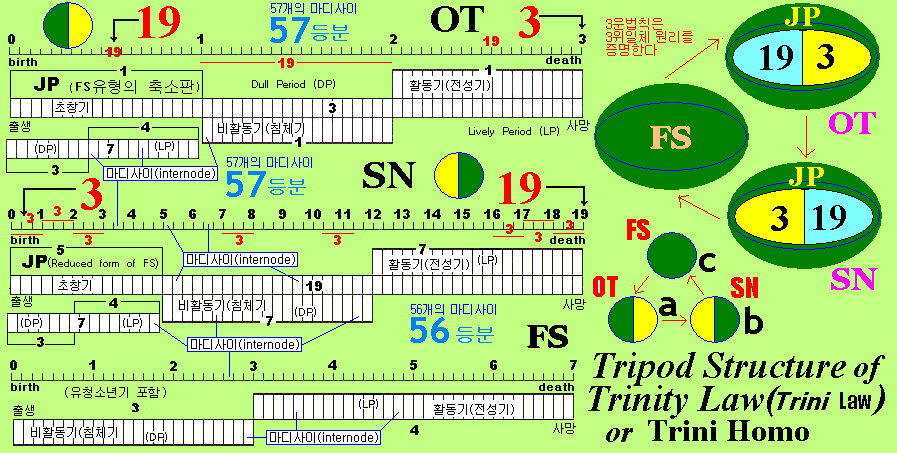
이 갑과 을의 57개의 "마디(정확히 말하면, 마디 사이)"라는 것은 바로 이 3과 19 사이의 도치성을 나타내기 위하여 정해진 것이라 봄이 옳겠다. 그리고 의미가 더 있으니 갑(OT)과 을(SN)은 57개 마디이지만 병으로서의 FS형은 56개라는 데에 있다. 즉 실체는 갑과 을이요 병은 갑, 을이 하나로 존재하고 활동하는 것을 나타내는 것일 뿐 '독자성을 지닌' 실체는 아닌 것이다. 그래서 차별화를 두되 너무 현격한 차별일 수 없고 단지 1차이의 구별을 나타내기 위해 FS형은 56개 마디이다. 3과 19와의 도치성을 나타낼 수 있고 뿐 아니라 FS형과 OT, SN형을 이상과 같이 구별해서 나타낼 수 있는 가장 적합한 숫자가 바로 이 56과 57이다. 이것이 셋째이다.


다음에는 갑에서 을로, 을에서 병으로, 병에서 갑으로, 그리고 다시 갑에서 을로 흐르는 흐름의 화살표는 어떻게 표시되었느냐 하면 위의 그림에서 보임과 같이 "같은 숫자는 끼리끼리 결착한다"고 전제해두면 을과 병은 숫자 7로써 통하고 통하기 때문에 을에서 병으로 흐른다는 것이고 병과 갑은 3으로써 통하니 역시 을로부터의 흐름을 이어 받아 병에서 갑으로 흐름을 나타내는 것. 그러면 갑에서 을로 흐르는 것을 어떻게 나타나져 있느냐, 그림에서 볼 수 있듯이 갑(OT형)은 LP, DP, JP 모두 균등, 균일하게 1/3씩이다. 다시 말해 네모 반듯하여 흠잡을 데가 없는 왕자의 생김새다. FS형이 LP, DP가 4/7, 3/7로 되어 있어 아름다운 형태를 취하고 있으나 갑에 비할 바가 아니다. 고로 갑(OT형)이 이 세 유형 FS, OT, SN 중에서 중심임을 드러내고 있는 것이다. 그러므로 갑에서 을로 흐름이 첫 가닥을 잡는다는 것은 당연지사. 그래서 갑→을→병→갑, 이렇게 해서 연속적으로 흐름이 이어져 갑과 을은 병이 모습 즉 하나의 모습으로 존재하는 것이다.
때문에 3위1체 원리는 3운법칙(인간 생애의 법칙)을, 3운법칙은 3위1체의 원리를 상호 검증하고 있는 것이다.






대칭성 원리 세상을 근원에서 규율하는 법칙은 인과율이다. 여기에 열역학 제 1법칙과 제 2법칙을 보탤 수 있다. 근대과학의 성과는 이 셋으로 전부 설명된다. 문제는 이 셋을 하나의 통합적인 시선으로 조망할 수 있느냐다. 구조론이 답을 제시한다. 근본은 하나다. 구조론으로 보면 열역학 제 1, 제 2 법칙, 곧 질량보존의 법칙과 엔트로피 증가의 법칙은 인과율로 대표되는 하나의 보편원리에 에너지를 태워 전개시킨 바 하부구조다. ‘원인이 있으면 결과도 있다’는 것이 인과율이다. 그런데 원인과 결과 사이에 무엇이 있는가? 대칭성이 있다. 원인과 결과는 마주보고 대칭된다. 그 대칭성이 원인과 결과 양자를 연결하는 고리 역할을 한다. 그것이 구조다. 구조는 어떤 독립된 둘을 연결하여 관계를 만든다. 관계를 맺어주고 유지시켜 준다. 남녀를 연결하는 것은 사랑, 임금과 신하를 연결하는 것은 충성, 점원과 고객을 연결하는 것은 신뢰다. 대칭되는 둘 사이에는 반드시 중간에서 연결하는 것이 있다. 사랑이니, 충성이니, 신뢰니 하는 추상적 표현들로 애매하게 얼버무려왔던 그것에 체계를 부여하여 과학의 언어로 엄밀하게 기술한 것이 구조다. 인과율에 기초한 수학적 사고가 근대과학의 토대라는 점은 학계에서 널리 받아들여지는 상식이다. 누구도 의심하지 않는다. 그러나 결함이 있다. 기존의 인과율은 시간상에서 성립하는 법칙으로 알려져 있다. 그러나 대칭을 이루는 시소의 두 날개는 동시에 움직인다. 수학에서 일반화 된 대칭성 개념은 시간과 무관하다. ‘1+1=2’라면 ‘=’를 중심으로 양변이 대칭된다. 기하학도 도형의 대칭원리 중심으로 전개된다. 인과법칙이 시간상에서만 작동하지는 않는다. 공간에서도 인과법칙은 작동한다. 무엇인가? 인과율 이전에 대칭성이 있다. 대수, 기하학적 대칭성에 에너지를 입혔을 때 비로소 인과율의 시간개념이 적용된다. 인과율은 순서가 있다. 항상 원인이 먼저고 결과가 뒤따른다. 그러나 인과율에 에너지를 태워 전개한 열역학 제 1법칙, 곧 질량보존의 법칙에서는 기하, 대수의 대칭과 마찬가지로 질과 양 사이에 순서가 없다. 그런데 열역학 제 2 법칙, 엔트로피 증가의 법칙에 와서는 순서가 있다. 원인이 먼저다. 이를 어떻게 받아들일 것인가? 평면적 관점이 아닌 입체적 관점으로의 비약이 필요하다. 통합적인 시선으로 이해하기다. 사실이지 인과율은 너무 나간 것이다. 열역학 1법칙이 먼저고 2법칙이 나중이다. 대칭성 원리가 먼저고, 거기에 에너지를 태워야 비로소 2법칙이 성립한다. 에너지를 태우기 전의 대칭성이 인과법칙에 앞선다. 기존의 인과율은 시간적 선후관계를 중심으로 기술되고 있지만 실제로는 공간에도 적용된다는 점이 문제로 된다. 시간에서 원인과 결과의 관계로 성립하는 것이 공간에서는 전체와 부분의 관계로 성립한다. 시간축이 선후관계라면 공간축은 종속관계다. 전체가 지배하고 부분은 종속된다. 시간에서 원인이 이끌고 결과가 뒤따르는 원리와 같다. 하나의 대칭성에 에너지를 태웠을 때 시간과 공간 양측면이 유도된 것이다. 인과율의 시간성과 공간성을 통일하는 것은 사건(event)개념과 일(work)개념이다. 인과법칙의 선후관계와 종속관계는 시공간상에서 일어나는 사건 안에서 규명된다. 사건이 없다면 원인도 없고 결과도 없다. 사건(event)은 주사위를 1회 던지는 것이다. 1회로 끝난다. 완결된다. 시작과 끝이 있다. 외적으로 닫혀있음이다. 존재의 독립성 의미가 있다. 이는 열역학 제 1법칙과 연관된다. 순환과 환원의 원리다. 사건은 반복된다. 제 1회로 던져진 주사위가 제 2회로 되던져질 때 원점으로 되돌아와 순환된다. 결과에서 원인으로 환원된다. 그 사이에 매듭이 있다. 제 1회와 제 2회는 동일한 것으로 판정되어 구분된다. 열역학 1법칙이 제 1회와 2회 사이에 칸을 나누어 단호하게 잘라버리는 것이다. 1회를 하나의 사건으로 독립시켜 버린다. 2회는 다른 사건이 된다. 여기서 시작과 끝의 대칭성이 드러나서 사건은 완결된다. 일(work)은 에너지 측면에서 고찰된다. 사건은 시작과 끝의 대칭으로 1회가 완결되며, 이때 시작 포지션에는 에너지가 있고 끝 포지션에는 에너지가 없다. 여기서 에너지의 입구와 출구가 드러난다. 사건의 입구와 출구 사이에서 일방향성을 드러내는 열역학 제 2법칙이다. 이는 존재의 기능 측면을 드러낸다. 그렇다. 존재는 명목과 기능의 집합이다. 존재(存在)는 존(存)과 재(在)의 집합으로 성립된다. 존(存)은 명목을 지시하고 재(在)는 기능을 지시한다. 존은 열역학 1법칙을, 재는 2법칙을 지시한다. 인과율은 이 지점에서 열역학 1, 2법칙을 완전히 통일한다. 셋은 하나의 원리가 가지는 여러 측면이다. 시간개념 위주의 인과율은 에너지를 태워 존재를 전개한 것이다. 그 이전단계인 대칭성 원리가 원본 모형이다. 대칭성 원리는 기하학과 대수학에서 다루어지며 존재로 전개하기 이전의 순수한 형태다. 대칭성은 2가 1을 겸하는 것이다. 여기서 일의적 동시결정원리가 성립한다. 과거와 미래 2는 현재에 의해 1이 된다. 이것이 시간의 인과율이다. 시소의 좌우 두 날개는 축에 의해 1이 된다. 공간의 인과율이다. 1이 2가 됨으로써 만유가 탄생한다. 위대한 낳음이 이룩된다. 세상은 그렇게 낳아서 전개하여 마침내 이룩된 세계다. 그 낳음의 원리, 창조의 원리, 진보의 원리가 이렇게 해명되었다. 망라하고 있다. 구조론은 인과율의 원인과 결과를 연결하는 대칭성을 해명한다. 축 1이 날개 2를 겸하는 정도에 따라 다섯가지 대칭이 있다. 다섯가지 포지션으로 인과율의 원인과 결과, 존재의 명목과 기능을 연결한다. 사건과 일, 그리고 열역학 1법칙과 2법칙을 인과율 하나로 통일해낸다. 관계를 맺어주고 관계를 발전시킨다. 에너지를 열고 닫는 스위치다. 그 방법으로 수학적 대칭성에 에너지를 태워 존재를 완성한다. 이로써 존재가 수학적 추상으로부터 어떻게 유도되는지 밝혀졌다. 철학적 사유의 궁극적인 출발점은 존재 개념이다. 데카르트가 제 1원인을 추구한 끝에 최종적으로 존재 개념에 도달한 예가 그러하다. 만유는 수학으로 되어 있으면서 동시에 물질로 되어 있다. 수학적 원리에 에너지를 입혀야 비로소 물질이 일어나 존재가 수립된다. 수학적 원리가 앞서고 물질적 법칙이 뒤따른다. 그 사이를 연결하는 것은 에너지다. 그 에너지를 제어하는 법칙이 구조론이다. 이렇게 인간의 수학과 자연의 물질이 어떻게 관계를 맺는지가 밝혀진 것이다. 수학적 추상의 세계와 구체적 물질의 세계가 만나는 접점이 해명되었다. http://gujoron.com
|


위의 옮겨 온 글(http://gujoron.com)에서 첨언하고 싶은 것은, 과학자든 그 누구든지 간에 "여기까지는 왔는데 그 다음은 무엇이고 어디냐" 해야지, "이제는 다 알았다, 결론을 내자" 하고 거기 안주(安住)하기 시작하면 그 여태까지 쌓아 온 지식마저 덕이 되지 못하고 발전에 "걸림돌"이 된다는 것이다. 3위1체의 원리는 그 걸림돌을 디딤돌로 삼아 초자연계를 넘겨다 볼 수 있게 하는 것이다. 이상 더 갈 곳이 없다 하여 오래 방치해 둠으로써 고장이 나 버린 "지식 탐구"라는 차(車)를 끌어다가 초자연계라는 차고의 수리소에 갖다 주어 새로운 안목으로 새 출발로 달리게 하는 견인차 역할인 것이다. 위의 옮겨 온 글에서는 따라서 몸만 있고 머리는 없는 셈이다. 대칭성 원리 등 몸에 관한 내용은 옳으나 머리 없는 몸이 되어 갈 바를 몰라 방황하는 형국이다. 창조자 하나님을 배제하는 모든 논리가 겪는 같은 운명이다. . 젊은 알렉산더가 동방 정략에 나서 페르시아를 단숨에 석권해버린 후 인더스 강변에 이르자 더 이상 정복할 땅이 없다고 지레 짐작으로 판단하여 결론을 내린 후 그 자리에서 대성통곡을 한 것과 같은 우를 범하지 말라는 것이다. 발 아래만 보지 말고 눈을 들어 광활한 지평선, 수평선을 쳐다보라는 것이다. 자연계 저너머의 초(반)자연계. 이 세계가 있으면 반드시 양세계로 병립해 있으니 그 반대 세계로 눈을 돌리라는 것이다. 지금까지의 모든 인간 의식이 이 자연계에만 한정되어 있었으니 얼마나 비극적 현실, 상황인가. 우물 안 개구리처럼 너무나 근시안적이었다. 자연계가 있으니 반드시 반대 자연계가 있다. 이것은 필연이다. 이 필연성을 지적해주는 것이 3운법칙과 상호 검증 관계에 있는 3위1체 원리의 사자후(獅子吼)다. 세상이라는 결과물이 있으니 그 배후에는 보이지 않는 창조자의 손길이 있다. 보이는 것이 있으니까 반드시 보이지 않는 것이 있게 마련이다. 이것이 대칭성의 원리다. 간단하게 생각해야지 복잡하고 어렵게 접근할 아무 이유가 없다. 이 세계의 생사(生死)가 있으니 반드시 오는 세계에서의 영원한 삶과 죽음이 있게 마련이다. 진화론을 질책하는 이유가 이렇게 확증된 창조자의 실재를 두고도 이를 부인하고 아직도 고집스럽게 무신론적 사고방식을 버리지 않기 때문이다. 이 세상의 한시성은 오는 세계에서의 영원성을 웅변하는 바로 그 근거 자체임을 3위1체의 법칙은 밝히는 것이다. 영원한 죽음. 이 죽음 즉 멸망은 존재의 인멸이 아니다. 대칭성 원리에서의 "정반대되는 성질"을 의미함이므로 생명의 쾌락과는 반대되는 일체의 것을 뜻한다. 이 엄숙한 현실 앞에서 두려워하고 떨지 않는다면 "이성 없는 짐승"(벧후 2:12)보다 나을 것이 무엇이랴. 인생의 유일무이의 과제는 바로 이 점에 있는 것이다. 이 세상을 사랑하게 되면 반드시 오는 세상으로부터 미움만을 받을 것이다. 이것이 대칭성 원리다. 인과율이니, 대칭성 원리니 하는 것들이 지금까지 제대로 대접을 받아오지 못했다. 중구난방식으로 각기 자기 소견대로만 해 온 것이다. 그러나 3위1체의 원리로 그 모든 것이 이제는 확실한 자리 매김을 하게 된 것이니, 한 치 오차 없이 모든 것은 이를 따라 이루어질 것이다. |
2016년 4월 1일 금요일
송상절 박사 (2)
네이버 영어 사전 안내

CHAPTER TWELVE
With Bethel in South China 1931-1932
IN Shanghai the five young men, fresh from their hazardous and wonderfully successful campaign in Manchuria, received a tremendous welcome. They had been travelling and preaching for four months. But instead of taking the rest they deserved, they plunged at once into evangelistic meetings at Bethel where there were many new unconverted students in the nursing school. Some accepted Christ at each meeting.
Since the loss of Manchuria a threatening situation had developed in China proper. Shanghai was the next objective on the Japanese programme. Politicai tension was high. It was in such an atmosphere that the Band conducted meetings in the large Allen Memorial Church in Chapei at the invitation of the Shanghai Ministerial Association. It was not expected that, under the circumstances, there would be many at the meetings. But, from the first night, January ist, 1932, the church was crowded. The originally planned three days were extended for an extra three days and then again for four days more! For the last meeting, a densely packed audience crowded the church to overflowing, people from all the churches in Shanghai and many with no previous church connection being present. It was a wonderful climax to a campaign in which hundreds professed conversion and every church felt the breath of revival. Two weeks later, at midnight on January 28th, war broke out.
The Japanese army had landed at Woosung and was rapidly encircling the city. A heroic Chinese army fought fiercely but in vain. The Allen Memorial Church came under fire and some of the Chinese Christian workers were killed. Refugees poured into the safety of the International Settlement. The Bethel Mission had to evacuate its premises and move the hospital, the schools and the orphanage into the Settlement too. Bethel evangelists and doctors went into the refugee camps and did a splendid work of preaching and healing among the miserable people there.
The programme of the Worldwide Evangelistic Band included a Short Term Bible School in February. This now seemed to be out of the question. But eight delegates from Manchuria had already arrived and Dr. Sung was determined that they should not be disappointed. With fighting continuing all around, he and the other members of the Band held daily classes and took the students through twenty-three books of the Bible! Some of those attending were recent converts and they returned to commence work for God in their own homes.
A six months' itinerary through South China lay ahead of them, beginning in March, but even so there could be no relaxation for Dr. Sung. Just before the fighting broke out, he had assumed responsibility as chief editor of the Guide to Holiness, the Bethel magazine. In view of the long absence from Shanghai in prospect, he had recruited the entire Bethel staff to prepare material for the magazine for six months ahead. When war broke out with the complete disruption of the work of Bethel, it would have been impossible to continue the regular publication of the magazine had not this provision already been made. As it was, the magazine was able to continue publication all through the ensuing months. And, incidentally, the Band had brought back from Manchuria 800 new paid subscriptions!
With great difficulty, steamer passages to Hong Kong were secured for the Band at the beginning of March. When the vessel reached Hong Kong on Friday, March 4th, it was placed in quarantine for smallpox! A crowd of Christians from the Peniel Mission waited on the quay to welcome them - but in vain.
On Saturday afternoon they hired a launch to go out to the ship at its quarantine station. Songs and shouts of joy were exchanged, but it was Sunday, March 6th, before the Band could land. They proceeded straight to the evening service, at which nearly 1,000 people were waiting, crowded into a chapei built to seat only 500. Dr. Sung preached that first night after a bright musical introduction. In. this British colony, English was well understood, so he preached in English while Philip Lee interpreted into Cantonese.
For two hours the burning words poured out - preacher and interpreter speaking in rapid succession. Thereafter, three services were held daily, none of them less than two hours in duration, and the meetings went on for six days. Dr. Sung and Andrew Gih shared the preaching. Sickness and loss of voice sometimes threatened to cripple their ministry, but God took them right through to the end. Rich and poor, high and low, dwellers in mansions and house-boats, educated and illiterate, those dressed in silk and those in rags, members of all denominations met in the Peniel Mission Church. Some came over the ferry from Hong Kong and some even came from Cheung Chau Island, an hour's journey away by launch.
There were many outstanding conversions and a number of the leading men in the Hong Kong and Kowloon churches trace their spiritual awakening and conversion to the ministry of Dr. Sung. One whose life was deeply influenced by him is an independem evangelist who has repeatedly visited every part of Hong Kong and Kowloon preaching the Gospel - including all the refugee and squatters huts - and he has led many to the Lord.
It was at Kowloon that the Band as such held their first meeting to pray for the sick. During the meetings some of the Band had been raised up from attacks of malaria arid other complaints in answer to prayer. Now people came with their sicknesses to ask for prayer. "What could we do?" they said. "We said to one another, 'What would Jesus do if He were here?' " About fifty people, therefore, were invited to attend a special meeting. Dr. Sung preached to them urging them to confess their sins, pray to Jesus and exercise faith. Everyone confessed their sins. Then Dr. Sung and Andrew Gih laid hands on them one by one and prayed for them. At a praise meeting the same evening many, including missionaries, testified to having been healed of varying complaints.
On March I2th the Band crossed to the Chinese mainland for meetings in the large and palatial Union Church. For the first two days the church was only partly full and they were driven to prayer. God heard and the evening services were soon being attended by big crowds. Amidst the formalism, the wealth and the worldliness of the Hong Kong church life they preached Jesus and His Cross. The Holy Spirit again worked powerfully and the after services were crowded with people seeking Christ. Towards the end, the whole auditorium became a "Counselling Room". Dr. Sung's messages were particularly full of power. Restitution and confession resulted and missionaries were moved as well as the Chinese Christians.
One praying mother had an atheist son who had been to America three times in the course of his education. This man hated his mother for praying for him and had even contemplated murdering her. When he was invited to the meetings by a friend he consented to go, "just to see that madman Sung jumping around the platform"! But he came under deep conviction of sin and knelt where he was to make his confession to God. Then he went over to the side of the church, where the women, in Chinese tradition, were segregated, and sought out his mother. With a trembling voice he asked her forgiveness and she sobbed aloud as she praised God for answering her prayers of long years.
From Canton the Band travelled up the Pearl River to Wuchow in the province of Kwangsi where both the city churches had only small congregations. The Christian and Missionary Alliance also had a Bible School. One of the students there, Mr. Newman Shih, had been deeply blessed through the ministry of the Band in Shanghai in 1931 at the summer Bible Conference at Bethel. He had prepared the other students to expect something really great. But after the first meeting on March 27th they were so disappointed that Mr. Shih came in for a good deal of criticism. The second day, however, the power of God rested on Dr. Sung as he preached and there was a deep searching work of the Holy Spirit in all hearts. Neither students nor faculty could resist the Spirit. The Principal was the first to go to the front, and he was followed by the whole student body and many of the church members. They all knelt in the presence of the Lord and confessed their sins with tears. Throughout the whole ten days there was a continuous and deepening work of God's Spirit. Whole nights were spent in prayer and the blessing overflowed to the whole city and district. One woman was convicted of the theft of a gold bracelet over twenty years before. Its current value was about $300, and she now gave it to the Band.
The night before leaving Wuchow, John Sung found himself singing in his sleep, "Without Me, without Me, witliout Me ye can do nothing. Cast forth, cast forth, cast forth as a branch and burned. Without me ye can do nothing." He awoke weeping.
Strangely enough, the Chinese character for Wu of Wuchow suggests a Cross and a Self. And in this John saw a warning that unless he daily yielded the old Self to the Cross, he too would be cast forth as a branch and be burned. A single theme was constantly in his mind at this time: "Though I have (this, that and the other) and have not love, I am nothing."
At Kweihsien, two lady missionaries were in charge of a school for blind girls. The church was very small. The ladies spared nothing in their love for the girls but few of them had been converted they were still without God and without hope. As the meetings went on, others were blessed but there was no move among the girls. They seemed as cold and as hard as stone. John Sung was deeply concerned and longed for them to know the love and the care of a Heavenly Father. As he pleaded with them one day, the break came. Their hearts were melted by the love of God and they gladly received the Saviour.
When invitations came to the Band from Nanning and Yulin, lots were again cast and Sung, Lee and Nieh were directed to Yulin. The church there was supposed to be a flourishing one, but the educational standard of the members was so low that John had great difriculty in preachirig to them. Add to this a lack of oneness of heart among the diree team members and an unsympathetic interpreter and the result was no blessing. "... If I have not love, I am nothing."
The Band now returned to Canton for meetings in the Baptist Church, led by Andrew Gih, who later went on to Swatow. The rest of the Band returned to Hong Kong on April 2oth for a second enthusiastic campaign, which continued until May first. On that day a very large crowd attended the Peniel Mission Church for a baptismal service, in which Dr. Sung had been invited to take part.
"But I have never been baptized by immersion myself!" he objected. Then he added that if Mr. Reiton would baptize him first, he would baptize the others. So the Rev. A. K. Reiton first immersed Dr. Sung, and then Dr. Sung in turn baptized twentyone women and twelve men. Did such an event have any precedent?
On May 2nd the Band began a simultaneous campaign at both the Methodist Church (in the morning) and the Hop Yat Tong (Love Church) in the evening - both churches on the island of Hong Kong. Dr. Sung preached powerfully toiarge crowds for a week, the other members of the Band leading the singing and dealing with the enquirers: Andrew Gih used to conduct the prayer meetings. May 8th was Sunday and their last day. Dr. Sung preached at the Peniel Mission church in Kowloon in the morning and at Hop Yat Tong on the island in the evening - a great day concluding a remarkable campaign.
In June, the Band travelled up the coast to the province of Fukien. Dr. Sung and Frank Ling remained in Foochow while Andrew Gih, Philip Lee and Lincoln Nieh travelled over the road so familiar to John Sung and his father to Hinghwa. They travelled partly by sedan chair, pardy by rickshaw and partly by river launch and all through torrential rain. John had elected not to go with them to his old home town for he said, "No prophet is accepted in his own country and with his own people!" Both at Hinghwa and at Sienyu there was the kind of divine work which breaks down barriers and sweeps away personal enmities, bringing Christians together in a grand unity of thought and purpose. The favourite choras was "The Blood shall never lose its power".
The Rev. W. B. Cole wrote of great victories won and an entirely new spirit introduced into the church, the Bible School and the church high schools. People who had long been estranged from each other became reconciled and there was a revived spirit of witness and prayer.
Meanwhile, in Foochow John Sung and Frank Ling experienced a time of marvellous blessing, perhaps greater than anything witnessed hitherto. At first there were no great crowds and it was examination time for the schools. But Dr. Sung's reputation spread fast. Many young people from the mission schools and from many Government schools as well began to attend the meeting.
They used to stay in the church from ten in the morning right on until after the three o'clock meeting. They were afraid to go away for lunch lest they lose their seats! Four hundred university students were once among the congregation. Dr. Sung poured out bis heart and soul day after day in delivering God's Word. The break came in the second week when hundreds of people were born again, confessing their sins to God. Students made restitution to their teachers, reconciliations were a daily occurrence and joy overflowed into the streets as the students returned home in groups singing. Twenty-seven consecutive days of incessant rain and dehberate attempts by their schoolteachers to prevent the boys and girls from attending could not keep people away from the meetings. The young people worked through the night at their lessons so as to be able to attend the meetings by day.
Dr. Sung depended on Frank Ling for interpretation, and even the death of Frank's little daughter was not allowed to interfere with the meetings. Frank went straight from the graveside to the platform. Towards the end of the time in Foochow, Dr. Sung received threatening letters to the effect: "Leave Foochow or we will put you in gaol!" The walls of the city were plastered with anti-Sung slogans! The daily newspapers attacked him. But during the month, over 1,000 young people were won for Christ, many of them formerly following a materialist philosophy and being open enemies of Christianity.
They used to stay in the church from ten in the morning right on until after the three o'clock meeting. They were afraid to go away for lunch lest they lose their seats! Four hundred university students were once among the congregation. Dr. Sung poured out bis heart and soul day after day in delivering God's Word. The break came in the second week when hundreds of people were born again, confessing their sins to God. Students made restitution to their teachers, reconciliations were a daily occurrence and joy overflowed into the streets as the students returned home in groups singing. Twenty-seven consecutive days of incessant rain and dehberate attempts by their schoolteachers to prevent the boys and girls from attending could not keep people away from the meetings. The young people worked through the night at their lessons so as to be able to attend the meetings by day.
Dr. Sung depended on Frank Ling for interpretation, and even the death of Frank's little daughter was not allowed to interfere with the meetings. Frank went straight from the graveside to the platform. Towards the end of the time in Foochow, Dr. Sung received threatening letters to the effect: "Leave Foochow or we will put you in gaol!" The walls of the city were plastered with anti-Sung slogans! The daily newspapers attacked him. But during the month, over 1,000 young people were won for Christ, many of them formerly following a materialist philosophy and being open enemies of Christianity.
One hundred and twenty-seven of them paid their own way to Shanghai to attend the Bible Conference at Bethel in July. The 1932 Bible Conference at Bethel was the fifth such conference and lasted from July 4th to I4th. War conditions, interrupted communications and overcrowded transport did not deter the crowds from all over China from making the journey to Shanghai. A large proportion came from Soudi China - Foochow, Swatow and Hong Kong.
Bethel was hard put to it to secure accommodation for every one. Fifteen hundred people crowded the auditorium every day from morning to night. The interest and the blessing was so great that John Sung and Andrew Gili arranged a three weeks' Short Term Bible School for any delegates who could stay and pay their own expenses. One hundred and twenty students enrolled, and in spite of the great summer heat three hours were spent in. Bible study in the early mornings, evangelistic meetings were held every afternoon and in the evenings there were further studies in the Old Testament. In this way sixteen books of the Bible were covered.
Bethel was hard put to it to secure accommodation for every one. Fifteen hundred people crowded the auditorium every day from morning to night. The interest and the blessing was so great that John Sung and Andrew Gili arranged a three weeks' Short Term Bible School for any delegates who could stay and pay their own expenses. One hundred and twenty students enrolled, and in spite of the great summer heat three hours were spent in. Bible study in the early mornings, evangelistic meetings were held every afternoon and in the evenings there were further studies in the Old Testament. In this way sixteen books of the Bible were covered.
Since the last Conference in July, 1931, when Dr. Sung had made his first appearance, die Worldwide Evangelistic Band had travelled a total of 54,823 miles, holding 1,199 meetings! They had preached to over 400,000 people in thirteen provinces and over 18,000 decisions had been registered! They had rninistered to churches connected with thirteen missionary societies, and had left behind them an organization to ensure the proper "follow up" of all the converts.
After the Conference and the Short Term Bible School, John Sung, wim Philip Lee and Lincoln Nieh, returned to Kwangtung for a Baptist Summer Conference in Swatow during the latter part of August and early September. Owing to some objection to the practice of inviting people to the front of the church as a sign of decision, this was dropped. In the place of this, a prayer meeting was arranged every aftemoon for those seeking Christ.
Before long about 80 per cent. of the evening congregation were attending the prayer meeting. There was no preaching. People were meeting with God and dealing with their sins in His presence. Those were exhausting but deeply satisfying weeks of toil.
CHAPTER THIRTEEN
With Bethel in North China 1932-1933
THE crowning revival is on. All books sold out. Send more quickly." This was the cable received in Shanghai from Peking in October. In Peking, of all places, the Band might have expected a cool reception, for was not this the educational capital of China and the cultural heart of the nation? Only recendy it had been a hot-bed of anti-Christian sentiment. Yet there the evangelists witnessed the same mighty moving of the Spirit in the hearts of men.
Dr. Sung travelled by way of Hankow, where he spoke once while the rest of the Band went by the Tsinpu route, calling at Kaifeng, Loyang and Tsinan on the way. They all met in Peking towards the end of October, 1932. The anti-Christian movement had largely spent its force and the nation's hate was diverted to the Japanese aggressors. The Five-Year Movement of the Church had been launched as early as 1929 with its prayer watchword, "O Lord, revive Thy Church, beginning with me!"
Revival movements were now the order of the day, specially in North China. Shantung was witnessing many strange things. There were groups which emphasized repentance from sin and forgiveness through the Cross, but diere were others which spoke litde of sin and redemption and stressed only certain mystical and emotional experiences supposed to accompany the gift of the Holy Spirit. These movements were featured by a variety of psychical phenomena. It was in Shantung that the "Jesus Family"
originated. This movement was among the most extreme in its un-Scriptural emphasis, though its followers set a high example of zeal and self-sacrifice as they set out to preach the Gospel and to found communal colonies or "families" all over China. And it was in Shantung that the "Spiritual Gifts Society" had the most adherents.
The Bethel Bands went wherever they were welcomed, but avoidcd all extremes. And the revival which so often accompanied their work was of a healthy character. Their teaching was a corrective to the errors of the "Jesus Family", the "Spiritual Gifts Society", the "True Jesus Church" and other enthusiastic but scripturally ignorant groups of Christians. Dr. Paul Abbott, Chairman of the Shantung Mission of the American Presbyterian Mission, had had good opportunity to assess the work of the Bethel Band in North China and he made these observations in the 1932 China Christian Year Book: "Their work impresses one as sane and constructive with emotion released in laughter and song, under control and with no excesses or results to undo or live down. Their follow-up work with correspondence, prayer lists and printed material is skilfully carried on as part of their service to the churches."
In coming north, the Band left behind the green paddy fields of the south and exchanged them for the brown hills and ripened maize and millet fields which cover the northern plains. The mornings were already chilly, but the sun shining from cloudless skies shed a golden warmth over all throughout the middle of the day. As the train approached "the Ancient Capital", the party could see the azure-tiled roofs of the lovely Temple of Heaven, immediately south of the city. From the station outside the massive Chien Men (South Gate), the travellers were taken by car through the ancient walls into the outer or Tartar city. The walls of the inner or Imperial city had mostly disappeared to make way for modern building plans but, like the innermost box of a child's nest of boxes, the storied "Forbidden City" where generations of Chinese emperors had lived and died still wore an air of mystery and retained much of its former magnificence. The goldand green-glazed tiles of the palace roofs shone with a brightness that was dazzling. All traffic is forced to detour around the walls of the "Forbidden City" and, after passing the "Coal Hill" which guards the northern gate of the Palace, the members of the Band soon arrived at the American Presbyterian Mission compound.
John was at last in the city where the Peking National University had once ofFered him the Chair of Chemistry in its medical college. The Presbyterian church committee had not expected great crowds at the meetings and were rather surprised when, on the first day, there was a very good attendance. Each day began with a seven o'clock prayer meeting. Though the early mornings were cold and it was hardly light as the Christians met, there was nothing cold about the praying, whether by individuais or when all prayed in unison with a sound like waves breaking on a shingle beach. At ten o'clock Dr. Sung conducted the Bible studies. His original expositions and lively presentation of truth soon increased the attendance from the initial handful to over 200.
Andrew Gih preached at the big afternoon meeting and John Sung at the evening meeting, when the chapei was jammed with people, many standing outside the doors and windows to Hsten. As Dr. Sung preached, the Holy Spirit convicted of sin and rightecjusness and judgment. One night the Peking Chief of Police attended and the next night brought his whole family. All were clearly converted. The man himself confessed to the sin of murder, having secured the death of a man in order to get his money.
Andrew Gih preached at the big afternoon meeting and John Sung at the evening meeting, when the chapei was jammed with people, many standing outside the doors and windows to Hsten. As Dr. Sung preached, the Holy Spirit convicted of sin and rightecjusness and judgment. One night the Peking Chief of Police attended and the next night brought his whole family. All were clearly converted. The man himself confessed to the sin of murder, having secured the death of a man in order to get his money.
He had also obtained the lovely house in which he was living by illegal manipulation. Confession and restitution were followed by the joy of sins forgiven and the whole family started out on a new life in Christ. Another elderly ofEcial attended the meetings with his wife and a beautiful young concubine whom he had recently taken into the home. All three were converted and the bond between the husband and the girl was severed. An army oiEcer confessed to receiving large bribes and even one of the Christian ministers confessed to the misappropriation of church funds. It was calculated that a total sum of over $20,000 (,£1,250) in conscience money was returned, evidence of the fact that the preaching was both ethical and practical in its content. An old pastor said that he had seen nothing like it in the forty years he had been connected with the church. Rev. James P. Leynse of the American Presbyterian Mission wrote to the leaders of the Bethel Mission:
"Words fail me to tell you about the great crowning revival that has come to our station through the work of your Bethel Evangelistic Band. The Lord has answered our prayers far beyond our expectations.... Confessions of sins, conversions and the uplift of many Christians were daily occurrences.... Never before have I met a group of young men so completely devoted to their calling.... It was so strange to us reserved, formal Presbyterians to see the church members as one body break out into pubHc prayer and praise.... These men brought the saving knowledge of Jesus Christ, vision and strength for daily tasks, victory in sufFering and a passion for souls. Iamso thankful that our church realized in time the conditions to be observed before obtaining these great blessings - namely, continuance in prayer, in fellowship and in the truth of Christ's indwelling and a manifested longing to abandon ourselves to the will of our Lord. "
Another missionary wrote: "Let me bear my own testimony to the glorious freedom which has come to me. I came out to China to lead Chinese friends to Christ, and instead they have opened up to me His fullness!" The meetings in the Presbyterian church were followed by a mission in the Methodist church in the south city, just inside the Hata Men. Young people and employees from the schools, the hospitais and the theological seminary, with the outsiders who came in, filled every one of the 1,200 seats. Many of the young people were brought to real faith in Christ as Saviour during the meetings. Ten of the seminary students went to see Dr. Sung one day to tell him that they had lost their faith since entering the seminary. When Dr. Sung advised them to leave if this was the case, the principal went post-haste to see Dr. Sung, who told him quite bluntly: "If the students lose their faith in Christ while in your seminary, you ought to feel that something is wrong!"
Dr. Sung took an unflinching, unfaltering stand in this centre of liberal Christianity in China in denouncing all unfaithfiuness to the Word of God. Neither fear of man nor respect of persons were allowed to deter him.
On October 31 st Dr. Sung commenced a third series of revival meetings in the Salvation Army auditorium, the largest in the city. The hall was packed every night and as the revival continued many found Christ. On November 6th the Band began their last campaign in the American Board Mission church, which seats 1,500 people. During the month, John alone interviewed over 1,000 persons in addition to preaching at least twice every day. Hundreds of preaching bands were organized and the little banners bearing the red cross became a famihar sight all over the city.
But such a moving of God's Spirit was not left unchallenged by the Enemy. One of the church elders had formerly been connected with a flood relief organization and had misappropriated $50,000. When convicted of this sin, he had been unwilling to "open the coffin", and even suspected that Dr. Sung was directing his attacks at him personally, whereas, of course, John knew nothing of the man's past. This man, in his rage, took 200 students to the church one night determined to break up the meeting. The prearranged time was 7.30 p.m. John was preaching that night on Paul and Silas in prison and the chorus for the evening was "He can break every fetter!" The elder and his gang were waiting outside the church when suddenly at seven o'clock he was arrested by the police to answer for his crime. Thus did the Lord protect His servant and frustrate the designs of the enemy. But thereafter the Christians provided an escort each night to and from the church.
In the Presbyterian girls' high school there was an exceptional movement of the Spirit. The school authorities could not go all the way with Dr. Sung, but recognized that he was an instrument being used of God. Miss Bowden Smith, one of the teaching staff, asked Dr. Sung after a sermon on Naaman the Syrian why he had found it necessary to jump ofF the platform seven times by way of illustration! "Because", he replied, "people need to be impressed with exaetly what the Bible says about dipping in Jordan seven times. Patience and perseverance need to be emphasized as well as strict obedience." There was no doubt about the effect of such preaching on the girls. Over ten of them registered their names to go to Shanghai to attend the Bethel Bible School and prepare themselves for the Lord's service. Many began at once to witness and organized themselves into witness bands.
In assessing the results of Dr. Sung's visit to Peking, the Rev. C. Stanley Smith of the American Presbyterian Mission declared that he had "exerted a very great influence in Peking". So great, indeed, was his influence that pressure was brought to bear on him to remain in Peking in a permanent pastorate. This, however, was a suggestion that had no attraction for a man with a vision that took in the whole of China.
From Peking, the rest of the Band went on a first visit to the mountainous province of Shansi, where they were gready used to stir up the churches - and the missionaries too! But to Dr. Sung had come an invitation from the churches of Tientsin, who sent a representative to urge him to go. After prayer, it seemed right to respond to this call. The inter-church comrnittee arranged meetings in the large Methodist church to last ten days. It was said that there never had been revival meetings in that church before and that people had never been invited to kneel down to pray! Many of the church members at first objected to Dr. Sung's methods, but as the meetings went on the Spirit of God broke through the opposition, and some of those who had been critical personally visited Dr. Sung in his rooms at the Y.M.C.A. to pray with him. There was, for example, a well-known lady, a returned student from America, who became like a little child in her humility and simplicity of faith. Another lady, on the other hand, who was the concubine of an opium-smoking Army ofiicer wanted to believe, but was unwilling to give up her liaison. She persistently resisted the Holy Spirit's conviction and finally went out of her mind. A warning to unrepentant sinners!
Among the nominal Christians who attended the meetings was a man by the name of Meng Chao-ran, an utterly worldly character taken up with gambling, drinking and pleasure. He was convicted, converted and consecrated to God's service all in a few days. Subsequently he became the travelling secretary of the North-west Church Association and exercised a wide and fruitful ministry in the provinces of Kansu and Chinghai.
After the first mission was over, there came an urgent invitation from some young people to hold meetings in the south suburb Methodist church. The meetings were held, though in opposition to the wishes of the church pastor. But after eight days' meetings all opposition had been swept away and a number of wealthy families were won for Christ and have continued ever since to be loyal supporters of the church. It is no wonder that here too the Devil did his utmost to wreck the work. On the last day a madman tried to make a murderous attack on John Sung with a knife, but was forcibly prevented. It was in Tientsin that the strongest Preaching Band organization up to date was formed, and fifty small bands were left behind to witness for Christ throughout the city. Several hundred rejoicing believers saw John offon the train to Peking and one of them bought him a first-class ticket. "This was the first time I had experienced such luxury", he said, "but I did not really enjoy it or feel comfortable!"
From Peking, John Sung went south on his way back to Shanghai. En route, he stopped offat the important railway junction town of Chengchow. As there were no churches large enough for a united mission, a tent was erected. The weather was bitterly cold and the wind howled around the tent. Most of the people who came were simple country people and poor children orFthe street. This was a great contrast to the meetings of Tientsin, but John was impressed with the necessity of training Christians in the cities to go out into the villages to evangelize.
The simple life of the villages, he reflected, would be a healthy change for them from the worldly life of the cities. Village people were, moreover, more humble and would often quite spontaneously make public confession of their sins. Among the city Christians two preachers were revived, a Post Office official was saved and two young women dedicated their lives for fulltime service.
On arrival back in Shanghai, John found that the others had not yet returned from their tour of Shansi. Some of the leaders at Bethel were inclined to be critical of John for keeping to the big eities while the others went to the smaller and more out-of-the-way places. To this his answer was: " What attracted me about the big eities was not the comfort to be found there, but sinners in large numbers. The cross we all had to bear was different in each case. Living conditions might be more rigorous in the country towns, but in the big city campaigns the strain on one's physical and nervous strength was greater, the work itself was harder, and the opposition greater. The sowing of the seed had to be watered by sweat and tears. There was no question of my choosing the more comfortable pathway!"
When the rest of the Band retumed, the whole group reached an understanding that they would not again divide up or allow diiferences of opinion to weaken their strength. In planning their future campaigns, they would seek a closer co-operation and the clear leading of God.
The increasingly serious poKtical situation in relation to Japan had decided the Bethel Band leaders to move the Bible School and Nursing School to Hongkong, while the orphanage work was to be moved to Taming in North China. While the Band waited for the start of their next itinerary, John gave himself to editorial work on the Bethel magazine.
Early in 1933, the five men set out again for Shantung. The work being shared with the other four, Dr. Sung, to his great dissatisfaction, had less speaking to do. He was much happier when he was working to the full limit of his time and strength and he found his reduced preaching schedule not at all to his liking. At Tsinan, where John was paying his third visit, he concentrated chiefly on the Cheloo University students. The provincial Commissioner of Finance was then Mr. Ernest Yin, who, with his wife, was already a Christian. Now he had the joy of seeing his children find Christ. Mr. and Mrs. Yin went on to exercise an increasingly strong Christian innuence in Government and educational circles. Weihsien and Tsining were the next places visited. At Tsining some of the leaders were revived and the Governor of the Prison took Dr. Sung to preach to the prisoners.
Meetings followed at Hwanghsien and at Tengchow, where an unhappy state of friction and misunderstanding between the missionaries and the Chinese pastor was brought to an end. Chefoo, the lovely land-locked harbour and summer resort, was the next town to be visited. An unusual feature of the Band's work there was the blessing which came to the China Inland Mission school for British and American children, mostly the children of missionaries. Many of them wrote letters to Andrew Gih after his visit to tell him how they had accepted Christ or given their lives more wholly to Him. From Chefoo, members of the Band went on to Kaomi and Kiaochow, and everywhere the preaching of die Gospel in' its simplicity, but with a freshness that was unknown to many, achieved extraordinary results. This is what Dr. Paul Abbott reported of the work of the Bethel Band in Shantung:
"Bloodthirsty bandits, rapacious officials, overbearing soldiers, anarchistic students, dishonest servants, polygamists, sedate scholars, business-men, rickshaw coolies, beggars, men and women, young and old, city-dwellers and country folks, were moved to confess and forsake sin and to make reparation and restitution." An impressive list indeed!
One illiterate woman, the wife of a wealthy business-man, found Christ during the meetings in Weihsien. Later the family moved to the north-west of China. Not only did this woman become a soul-winner, but through her faith and prayers her daughter was saved and trained for Christian service, being closely associated with the Chinese missionary society known as the "Back to Jerusalem Band."
In March the Band crossed over from Shantung into the province of Honan for meetings in Kaifeng, the provincial capital. After a disappointing start among the schoolboys of the Baptist high school, there were eventually about fifty who came out for Christ. At Kihsien, instead of the several hundred high school children they had expected, there were only a lot of simple country women and farmers. To get his message across, John used one of his dramatized Bible stories. But they still could not grasp what he was trying to teach. All they knew was that the thing to do was to "confess sin". They would go on confessing sin over and over again indefinitely! So when he could not bring them to an assurance of forgiveness any other way, he ofTered to lay hands on them and pray for them. Immediately, they seemed to experience the joy of forgiveness and to have a more intelligent understanding of the preaching.
The Team was without Andrew Gih when they went back to Kaifeng for meetings in the Free Methodist Church. This time they had the fullest possible co-operation and sympathy from the missionaries, among whom was the Rev. James Taylor, a grandson of Hudson Taylor, the founder of the China Inland Mission.
One day there was a deep work of the Holy Spirit which led many to confess their faults one to another. Prayer and confession went on for about four hours. As on Mt. Carmel, the fire of the Lord fell and consumed the sacrifice. The 700 or 800 people present were caught up in a great song of praise and thanksgiving to God.
At Changteh, the missionaries were liberal in their theology and were opposed to the evangelical doctrine of the Blood of Christ and all that "out-of-date stuff". John was undeterred by this and as usual wielded the two-edged sword of the Spirit, preaching the great and essential truths of salvation. The whole congregation was so moved that they all began to cry to God, among them the pastor of the church, who acknowledged that he was not born again. After being truly converted, he determined that he would henceforth preach only the fundamental doctrines of the faith.
The Band continued its journey north through ripening harvest fields of wheat, along the Tsinpu line into Hopeh. Their next meetings took place in Shihkiachwang, the junction for the railway into Shansi. The meetings were held in the Assemblies of God Church, where the emphasis was principally on the speaking with tongues. But it soon became clear that many who claimed to have spoken with tongues had never really repented of sin. They too needed to confess and get right with God. What a sinner needs, John emphasized, is not the gift of tongues or any other such gift, but the gift of salvation. To seek the gifts without first dealing with sin is a dangerous thing, which all too often leads to the deceptions of the Devil! Some twenty missionaries from the surrounding cities attended these meetings and were themselves deeply moved. They went back to their work with a new zeal and a new faith in the power of the Word of God.
From Hopeh a narrow gauge railway winds its way through interesting mountain scenery up into Shansi. Taiyuan, the provincial capital, is the terminus of the line, and was the next destination of the Band. The English Baptist Mission had all the usual mission institutions there - schools, hospital, orphanage and church. John was suffering from a bad cough and was kindly entertained in the doctor's home, where his cough was cared for.
He was unwell and unable to give of his best to the work. On the whole, there was not a good reception for the message of the Band and there were only a few saved. The next Shansi city to be visited was Pingting, where, as in Taiyuan, the liberal element was strong. Foliowing the dismissal of a pastor by the missionaries for misconduct, the atmosphere in the church was very unhappy. The Principal of the church school was also outspoken in his opposition to the Band and their message. In spite of his cough, Dr. Sung followed his usual line and powerfully inveighed against church leaders who were not faithful to their tasks. "Dry bones! ... Stones of stumbling!" he called them. But they were stung in their consciences and at last came to the place of confession of sin. The dismissed pastor confessed his covetousness and admitted that he had been just a professional preacher! With sin put away and the wrongs in the church put right, the storm in the Pingting church became a calm. The leaders were all revived and the future took on an entirely new complexion.
The church at Pingyao was the result of the faithful preaching of workers connected with the China Inland Mission. Although there was no modernism in the China Inland Mission field, Dr. Sung attributed the noticeable lack of leadership to the absence of any extensive educational work in the area. This was the sphere of the labours of Pastor Hsi Sheng-mo, to whose labours many of the churches owed their origin. The churches were small in numbers compared with the Honan and Shantung churches and they were certainly far behind in education and culture compared with many which the Band had visited. These Were mountain people and despite all their intellectual handicaps they were honest, sincere believers and were to stand as firm as any Christians in China in the years of war and trial that lay ahead.
They also gave a larger place to the time-honoured courtesies of the Chinese than these semi-Westernized young men from the coast, and consequently they found it hard to reconcile the manifest zeal of the preachers with what appeared to them as their uncouth and unspiritual behaviour. No doubt this detracted from the eifect of their message.
The final campaign before the Bethel Conference in Shanghai was at Hungtung, the administrative centre of the entire China Inland Mission field in Shansi. This area covered thirty-eight counties. The visit of Dr. Sung and his companions had been arranged to coincide with the biennial delegate conference, and there were many missionaries present too. Hungtung had both a high school and a Bible School, so that the audiences to hear the Bethel preachers were reasonably large. It was decided to devote the first three days of the conference entirely to revival meetings, and the last three days would be given to business. It was at this conference that the events recorded in the prologue took place.
Those stirring days are a vivid memory still for all those who were present, Chinese and missionaries alike. Very tired after their extensive travels, the Band travelled back to Shanghai for the Bethel Conference. The guest speakers were the Rev. Marcus Cheng and Dr. French Oliver. Dr. Oliver and Dr. Sung shared the morning meetings. Unfortunately the two men disagreed on whether or not Christians would pass through the Great Tribulation! And Dr. Sung was not one to let the matter lie! His platform polemics must have been embarrassing to the leaders of the Bethel Mission!
Dr. Sung records that the lessons he learned from the experiences of the last six months were the lessons of Mt. Carmel; the distinction between the true and the false, that which is of the flesh and that which is of the Spirit. The fire of the Spirit was not to be expected in response to the shouting and the noisy fren2y of the false prophets. It was the quiet confidence and faith of Elijah that brought the fire down. The self life must be consumed before the cry, "The Lord, He is the God!" will be heard. Only the Spirit's fire can do away with the differences which divide Christians, melt their hearts and unite them in true harmony and fellowship.
CHAPTER FOURTEEN
Last Months with Bethel
IMMEDIATELY after the 1933 Bethel Conference, Philip Lee, the musician of the Band, sailed for America to study music at the Moody Bible Institute. Lincoln Nieh took up work at Bethel and the Band was reduced to three. John Sung and Andrew Gih now paid a hurried visit to Kwangtung for missions in several towns, before their next tour to the far north of China. The Bethel leaders at this time issued fresh instructions to the Band about the division of the work. There were also restrictions placed on Dr. Sung as editor of the Guide to Holiness, and it is clear that Dr. Sung's relations with the Bethel authorities were becoming uneasy. John records in his diary that his only desire was to walk with the Lord by any way He should choose.
But quite evidently serious difficulties lay ahead of him. The present itinerary was to take the Band up to the border provinces which were once a part of Inner Mongolia. The ancient city of Kalgan is the capital of the province of Chahar, and is a modern city of 200,000 people with several churches in it, though none of them large. Three days' meetings were held in each of three churches; the Norwegian Mission church, the Salvation Army and the Methodist Protestant church. But there were few evidences of the Spirit's working. Even in this remote place they found that liberalism and modernism had sapped the life and witness of the church. Social conditions and the general lawlessness and disrespect for human life greatly saddened the Band.
From Kalgan they proceeded by rail to Kweihwa in Suiyuan, where a retreat for about 150 leaders from all the China Inland Mission stations and churches in the province had been arranged. Those who attended had had to accustom themselves to working under the most difficult conditions. Banditry was rife and there were all kinds of discouragements to the would-be witness for Christ. But at the meetings there were many whose hearts the Lord touched and who sought Him for forgiveness and power in service. There was some friction, however, among the three Band members and this partially crippled their witness. John Sung was very sad at heart over the situation, but set himself to learn the lessons which spiritual defeat could teach. An investigation of the financial methods of a "Jesus Family" community in Kweihwa was a further warning to him of the dangers that exist where the financial aspect of the Lord's work is given undue prominence. It is then that division all too easily occurs.
Paotowchen is the terminus of the line from Peking to the Inner Mongolian border and in this city another 100 or 200 Christians connected with the China Inland Mission (Swedish Alliance Mission) gathered to hear the Bethel preachers. Among some of the casual members of the audience were two women who had fallen on hard times and desperately needed comfort.
One of them had been deceived into marrying a man who turned out to be an opium-smoker and to have one wife already. Broken-hearted, this woman had herself taken to opium smoking, drinking, gambling and theatre-going. Finding no comfort in any of these things she was contemplating suicide when she heard about the meetings and went along to hear. Gladly she responded and accepted the Saviour.
From Paotow, the Band went on to Saratsi, where there was a large orphanage for girls conducted by the China Inland Mission (Swedish Ailiance Mission). The Mongolian border is notorious for the number of baby girls who are thrown out to die or are killed at birth and then thrown away. To save such children the orphanage existed. But few of them, it seemed, grew up as Christians, and most of them were married into heathen homes.
There were altogether 500 or 600 people present at the meetings, a large proportion of them from the orphanage, and many of the orphans came to a clear experience of salvation. The three evangelists were taken on camel back to visit the ucarby cemetery, where the missionary victims of the Boxer Rebellion were buried. They paused to remember those who had gone before and sown the seed of a harvest which others, themselves included, were now reaping.
The Band travelled back to Paoting by way of Peking, for another conference. Great crowds attended the four daily meetings. There were so many who wanted private interviews that Andrew Gih and John Sung took it in turns to be at their disposal. Scores were fired with an enthusiasm and given a boldness in testimony that had been unknown before. One of the missionaries described the conference as the most wonderful thing that ever happened to Paoting. "Everyone", she wrote, "loves the Bethel Band more than ever, with the exception of a few dry sticks who haven't caught fire yet!"
Travelhng on south through Honan, the Band paid a return visit to Changteh. This time, instead of just 200 or so people, there were o ver 1,000, and there was much fruit from the proclamation of the same old truths. The converted pastor had been making great strides and the whole situation in the church had been completely changed since the Bethel Band had first visited the city. What the lifeless intellectuaHsm of liberal theologians will never accomplish, the faithful presentation of the Gospel in its simplicity and its clarity had accomplished in a few short months.
In November, the three men went south to the Hunan capital city of Changsha. AGerman missionary of the Liebenzell Mission, an associate of the C.I.M., well remembers her reception by Dr. Eitel of the Hudson Taylor Memorial Hospital as she arrived in the city after a very arduousjourney from Shanghai: "Leave your things and jump into the rickshaw! The meeting is due to begin and we won't get a seat if we are late!"
So instead of a restful welcome and a quiet cup of tea, she found herself on the way to a revival meeting while her companion hastily explained that the whole city was astir as the result of the visit of the Bethel Band. The doctor and the other missionaries were obviously excited and full of joy at what was happening. Hunan was the last province to open its doors to the messengers of the Gospel. Until recent times it had been notoriously anti-Christian. Changsha is the city where Hudson Taylor, the great pioneer missionary of inland China, died and where a hospital was erected in his memory. There was also a large Bible Institute affiliated with the Bible Institute of Los Angeles, and there were important Government and missionary educational institutions in the city. This was the place which the three Bethel Band evangelists had now taken by storm.
The sermon to which the newly arrived missionary found herself listening was on the Prodigal Son, and she had never heard the like before. All around her were sitting gentry, soldiers, peasants, old women, inmates of the Blind School, missionaries, Christians of many years standing and many a non-Christian attracted by the excitement. John Sung was preaching and Frank Ling was interpreting. With perspiration pouring down their faces and dashing oifglass after glass of water, the story was acted out with the usual drama and pathos and with plenty of local colour. At intervals in the sermon the choras "Come home! Come home!" was sung. At the conclusion, in that formerly anti-Christian stronghold, there was an amazing response to the invitation to come forward to accept Christ. Women who, at the outset, had looked stupid and wooden as if nothing could penetrate their dark minds were among them.
The Spirit of God had shined into their hearts and they were awakened souls. Those were glorious days. All three missions in the city had combined to sponsor the meetings and all shared in the joy of harvest. Not many years later Changsha became the cockpit of warring armies - Chinese and Japanese - and was partially put to the flames. It became a city of horror and bloodshed. But Changsha had had its day of visitation.
The Spirit of God had shined into their hearts and they were awakened souls. Those were glorious days. All three missions in the city had combined to sponsor the meetings and all shared in the joy of harvest. Not many years later Changsha became the cockpit of warring armies - Chinese and Japanese - and was partially put to the flames. It became a city of horror and bloodshed. But Changsha had had its day of visitation.
Changsha is also a place of tragedy as far as the Bethel Worldwide Evangelistic Band was concerned, for it was there that this instrument forged for the Lord's service, this band of flaming evangellsts was finally broken. On the journey to Changsha, Andrew Gih had conveyed the growing dissatisfaction of the Bethel leaders with John Sung's contribution; he did not teach the eradication of sin, he attracted converts to himself, and so his work would not last, and there was a persistent suspicion that he was receiving money gifts privately instead of passing them on to the Mission, John denied the last accusation; he was prepared to let time refute the second criticism and he did not believe in the doctrine of eradication; he preached the work of the Holy Spirit in mortifying the deeds of the flesh.
In Changsha, the Band were guests of the Rev. Marcus Cheng, who was on the faculty of the Changsha Bible Institute. Little did any of them know that this was to be their last campaign as a Band. Andrew Gih and John Sung shared the four meetings as usual, John taking the Bible studies and the evening revival meetings. The Presbyterian Mission, which had not at first been too cordial to Dr. Sung, later invited him to speak five times to gatherings of students numbering about 1,000. There were over 300 decisions for Christ the first night. The attendance grew daily until the hall became too small, and the number of decisions increased with each meeting. There was great rejoicing over this signal answer to prayer for the young people of the city.
One day, as the trio were having a meai between the meetings with Dr. Eitel and other Chinese and missionary friends, a telegram was handed to Andrew Gih from the Bethel Mission headquarters. In efiect, the telegram spelled the dissolution of the Worldwide Band. It contained a summons to Andrew Gih to return to Shanghai for the purpose of organizing two new Bands for work in the provinces of Kwangtung and Kwangsi. Andrew Gih was placed in a great dilemma. He had to choose between his loyalty to Bethel and his pledge to John Sung to work in undivided partnership with him. He felt obliged to comply with the instructions from Bethel and the die was cast. Sorrowfully, John and Frank saw Andrew offat the station. John Sung and Andrew Gih rarely met again!
When the meetings at Changsha had finished John Sung and Frank Ling went on to Changteh in the same province. The Canadian Holiness Mission chapei was small and the people attending the meetings were few. There were other churches and missions in the city, but co-operation was lacking. John comments in his journals that the existence of numerous denominations of foreign origin is one of the greatest hindrances to the spread of the gospel in China.
Pressure was now being placed on Frank Ling to return to Shanghai to join the newly organized Band, but he felt it his duty to complete the present itinerary with Dr. Sung. They returned to Changsha en route to Hengyang, and spent a day or two with the Rev. Marcus Cheng. There John himself received a letter asking him to return to Shanghai to make other arrangements for his family, who were living at Bethel. But both he and Frank decided to proceed with the Hengyang programme. An amusing thing happened to them there. They sent a telegram announcing the time of their arrival, signing it, "Sung, Ling." So they were very surprised to find no one to meet them at the train. They discovered the explanation later. Two other unrecognized Christians had come in from a neighbouring city and were seen to be carrying baggage. So the reception committee accosted them, enquired their names and, when they found their names were Sung and Ling, gave them a hearty welcome! Meanwhile, the real guests of honour were finding their own way to the church alone!
In Hengyang the three churches combined to arrange the special meetings. The following is the account of the campaign written by the Rev. J. R. Wilson of the Church Missionary Society immediately after the meetings: "Have you ever longed to meet a personality full of the glory of the Gospel who could present the message with a zeal and enthusiasm equal to his theme, a Pauline personality? ... The Chinese can be painfully matter-of-fact, and their services are often dull and unemotional.... Ever since coming to China twenty years ago, I have longed for someone to come and do what I cannot do - that is, to live and speak the glory of the Gospel. Then suddenly a living flame of Gospel zeal leapt upon us....
There had been some disappointment when the churches in Hengyang learned that Andrew Gih would not be coming as leader of the Bethel Band after all, because Dr. Sung, upon whom the burden of preaching would now fall, was reported to be a sensationalist and some feared that the mission would prove a failure. But Mr. Wilson's report continues:
"Dr. Sung brought us a great gale of reviving power from God Himself.... The Chinese confessed readily that this was no other than the boundless energy of the Spirit of God. For a whole week, twice a day, for two or more hours at each meeting, he poured out a living stream of searching Bible teaching, agonized prayer and ecstatic praise, all intensified by vivid acting, scathing sarcasm and exuberant humour. His physical antics were astonishing.
He leapt about the platform, he dashed offpoint after point on the blackboard, he made lessons stand out vividly with lightning sketches in chalk, he acted humorously, grotesquely even, to make a story live, he prayed with a fervour that seemed to pour out life itself and then, as a climax, when his message had been delivered, he would be transported with joy and glory for a full half-hour, while he carried us along on wave after wave of devotion and praise. It was a revelation! It was marvellously inspiring! The exceeding weight of glory found expression in a fellow human being, and it could not be denied.
"What was there in him to bring us lasting good? First he made Scripture live. Who can forget his rendering of Ezek. xxxvii? He held two dry bones in his hands. In mock show, he struck them one against the other like two dead church members engaged in a quarrel. 'Can dead bones hear the Word of the Lord?' he shouted. 'Praise God, they can!' There's hope for a dead church when the true Word of God is preached. Secondly, backsliders were searched as by a consuming fire. The man who fell among thieves was presented as a type of the church member who has been robbed by the Devil of faith, prayer, Scripture and left half-dead. Why does the Devil leave him half-dead and not finish him ofF? Because churches full of robbed and half-dead Christians will help the DeviTs cause more than anything else.
Live Christians must do the work of rescuing and restoring to the half-dead their treasures of faith, prayer and Scripture. Thirdly he led us to enthusiastic determination to follow Christ to the uttermost. We had a great morning when he led us up die Hill of the Beatitudes. Step by step each Beatitude was taken to represent steps in our Lord's life; from the Incarnation to Calvary At each step as we climbed higher and higher came the ringing call, 'Forward march!' and a stirring chorus. And so we struggled on to the summit 'persecuted for righteousness sake!
Suddenly we were startled by the Cross being planted on the final blackboard peak. Could we follow all the way to Calvary? ... "Oh, Jesus, make us all willing to follow Thee all the way!"
These words were written with the eiiects of the campaign vividly fresh in the memory. But twenty years later Mr. Wilson recollects those days in these words: "Such was the power of the presentation of the messages, that many of them are still vivid in my memory. Even the choruses are there in my mind all complete, indelible! ... Another outstanding memory was the afternoon when Dr. Sung invited anyone who wished to unburden their hearts to meet him privately. At the special request of my three Chinese colleagues, I went with them. After hearing their stories, very sad in places, and recording names and details in an enormous notebook, Dr. Sung gave the rest of the time to prayer. With tears streaming down his face, he agonized in prayer for us that we might be victorious over sin by the power of the Cross of Christ and the work of the Holy Spirit."
By the end of 1933, the Band had visited thirty-three cities in six months and had held 866 meetings at which over 14,000 people had made profession of salvation or of dedication of life to God's service; 729 preaching bands had been formed and nearly 3,000 young people had volunteered for whole-time service during this same period.
From Hengyang, where God was doing such great things, John, with a heavy heart, wrote letters to his friends in all the churches he visited announcing the end of his association with Bethel. Henceforth he would be working independently. But he had no plans. The future was blank. He did not even know where he was to find a place for his family. His joumal records: "I cried to the Lord for strength to go on preaching the Gospel with all my might without any anxieties for other things."
John, with his constant companion and faithful and expert interpreter, Frank Ling, returned to Shanghai, where he took his farewell from Bethel feeling like Abraham as he went out not knowing whither he went. So ended an uneasy association with the Bethel Mission. Undoubtedly after the three years of lonely and uphill toil in his own province, John Sung had seen the full fruition of his gifts and powers in this close fellowship for three years with Andrew Gih and his other colleagues. He had learned much from Andrew Gih. Even his theology had needed some straightening out at some points! The two men had been a powerful combination and their parting was as sad as the parting of Paul and Barnabas, and its eifect just as incalculable.
Dr. Mary Stone, the Chinese Director of the Bethel Mission, writes: "He was a wonderful man of God and a great blessing to many." Miss Betty Hu, writing from the present Bethel Headquarters in Pasadena, California, says of Dr. Sung: "I have never known anyone so powerful in his evangelism and yet so peculiar in his private life. He did the work of hundreds of preachers in those few short years."
But his boundless energy and his very success had placed stresses and strains both on the other members of the Band and on Sung himself. In particular, he could no longer tolerate being even partially under the direction of a foreigner ... and a woman too! From now on John Sung was to be a free and independent evangelist.
CHAPTER FIFTEEN
A Voice Crying 1934-1935
BY 1934, John Sung had become a well-known national figure in the Christian world of China. He headed a list published by the National Christian Council of six "notable personalities" among evangellcal leaders. His contribution to the revival which was sweeping over large parts of China, especially the north and the south, was considerable. Thousands had heard the gospel from his lips, and as a result had experienced a thorough-going conversion or a spiritual quickening.
Dr. Paul Abbott, writing in the 1932-1933 Christian YearBook, stated that "the work of these Bethel evangeHsts cannot be ignored in any estimate of present-day religious trends in China". The Rev. Laurence D. M. Wedderburn of the United Pree Church of Scotland Mission, on returning to Manchuria from furlough, found an entirely different spirit in the churches. All services were crowded and there was "an entirely new interest in Christianity, both inside and outside the church". He attributed this largely to the work of Dr. Sung, "an evangelist of power and persuasion". Another missionary somewhat depreciatingly declared that in Harbin the church was "almost fanatically wedded to revivahsm, following the visit of the Bethel Band, with Dr. Sung as the most effective preacher".
Everywhere, the visits of the Bethel Band had left a tremendous keenness for Bible study and a generally quickened life in the churches. It would indeed be hard to name a single province of north China where Dr. Sung and the Bethel Band had not left behind them a glorious record of spiritual blessing and lives cleansed and renewed and set on fire to serve God.
During 1934, Old Pastor Sung, John's father, died. John was far from home at the time and somewhere off the China coast on a small steamer on the Lord's business. As his father, unknown to him, was dying at home, John seemed to see him in a dream, standing by his side and saying to him: "Siong-ceh, I have gone to Heaven. But you have seven more years in which to work. So labour hard for the Lord!"
And labour hard he did. His reputation continued to spread rapidly and everywhere he went the crowds thronged to hear him - the homespun doctor of philosophy with his eccentric ways and unpredictable methods. People usually arrived two or three hours before the meetings were due to begin in order to be sure of seats. Then they sat on after one meeting until the time for the next to be sure to be present.
The meetings always began with singing, Sung himself sometimes conducting the singing with a white handkerchief. Often the audience would be asked to clap their hands to the time. Unison prayer followed. Then after a prayer by the preacher in a few brief sentences the sermon began. As John walked to the rostrum, he always had with him the precious book in which he had collected his daily jottings, though he seldom referred to it while preaching. On one occasion, while John was busy with a crowd of enquirers after the meeting, the book was forgotten and left lying on the pulpit. When he got back to his host's house he suddenly remembered it! Hungry as he was, he absolutely refused to sit down at table until the book was recovered. His companions waited and waited, singing hymns at the piano to help them forget their hunger, and only when the book was found and safely delivered did they sit down to dinner.
Dr. Sung at first spoke poor Mandarin and his enunciation even of his own Hinghwa dialect was not very clear. His interpreters needed to be versatile and quick-witted men. Frank Ling was such a one. The meetings, though lively, were always under control. He never allowed anyone to disturb the meeting, whether by shouting out an exuberant "Hallelujah!" or by getting up to leave early. Any such disturbances met with a stern rebuke.
Sermons were illustrated in a variety of ways. Grotesque blackboard drawings and scribbled sermon outlines were commonplace. Sometimes members of the audience or of the Band were called on to the platform to help him act out an illustration. A missionary was once ordered to stand with his arms outstretched while Sung preached on being crucified with Christ! Men were frequently tied up with rope and then released to illustrate the power of sin and the deliverance Christ can give. In one mission station the missionary had beautifully decorated the platform with all her palms, ferns and pots of geraniums. Dr. Sung was emphasizing the uselessness of half-measures in dealing with sin when he noticed the plants. "No use just pruning sin and cutting it down a little! You must pull it up by the roots!" And, suiting the action to the word, he set to work to pull the plants up one by one, strewing them about the floor. There were no floral decorations on the platform the next day! A favourite illustration for the need to be filled with the Holy Spirit was to have a lighted charcoal stove carried on to the platform.
Pieces of charcoal - dirty and cold - were said to be like most church members. And a specially large piece was, of course, the pastor! What they all needed was to get into the fire to make them glow till they were red hot! And he seldom resisted the temptation to point out that it took much longer for the large and self-important pastor to catch fire than for the others! Legends about Dr. Sung multiplied and people never lacked for conversation when groups of Christians got together to discuss the great "ice-breaker", as he came to be known.
Pieces of charcoal - dirty and cold - were said to be like most church members. And a specially large piece was, of course, the pastor! What they all needed was to get into the fire to make them glow till they were red hot! And he seldom resisted the temptation to point out that it took much longer for the large and self-important pastor to catch fire than for the others! Legends about Dr. Sung multiplied and people never lacked for conversation when groups of Christians got together to discuss the great "ice-breaker", as he came to be known.
At the end of every service, the preacher would always give an opportunity for anyone seeking repentance or some other grace to come to the front for prayer. Tears flowed freely as spiritual conflicts were fought and won, sins confessed, apologies made or restitution promised. Sung himself, certainly during the years when he shared the work with his colleagues in the Bethel Band, gave of his time and strength between the meetings to personal interviews, and there were numerous remarkable instances of divine blessing on his personal ministry: individuais were brought into the light and many a broken home reunited. John always recorded the names and addresses of such people and added them to his long prayer list. His extraordinary mind was able to memorize thousands of such names.
Not only were Chinese deeply affected, but many missionaries experienced spiritual refreshing too. Some even attributed their real conversion to his ministry. Soon after leaving Bethel, invitations began to reach John to speak at various Shanghai churches. The Foochow-speaking church was the first, and there he had a week's meetings at which sixty-three people found Christ. The name of the church was the Hall of Joy and Peace, and after his recent experiences John found comfort in the name! The next church to invite him was the Hall of Abundant Virtue, and there there were over ioo conversions.
Then the ministerial Forward Movement Committee arranged for three days' meetings for the whole of Shanghai in the Woods View Hall to coincide with the Spring Festival hohdays. Over 1,000 people attended the meetings. Finally, the Pure Heart Hall invited him for a week's meetings and about 200 school children professed to beheve. John took courage and looked forward to an even greater ministry than hitherto.
Several churches were competing to get Dr. Sung to be their pastor, so he began to pray: "Lord, if you want me still to be an itinerant evangelist, please open the door for campaigns in five provinces and send me $800 for my expenses within the next month!" As soon as news of Dr. Sung's new situation got abroad through the pages of Evangelism, Morning Star and other publications, invitations poured in. They came from the five provinces of Kiangsu, Chekiang, Anhwei, Hopeh and Shantung. And registered letters reached him from Changsha, Paoting, Peking, Shihkiachwang, Paotow, Saratsi and other cities, with money gifts ranging from $20 to $50, some of them from anonymous donors and others from people he did not know. The total exceeded the sum he had asked for! He was completely reassured.
"I offered myself again to serve my faithful, unchanging Lord. Come wind, come weather, through cloud and sunshine, if God is with me, I ask for nothing else."
John's first mission on his own outside Shanghai was at Chinkiang, a city some distance up the Yangtze River fiom the coast. He divided his time there between three churches and many found Christ, including some notable sinners. At Suchow South John spoke for the first time in Mandarin without an interpreter and was pleased to find that he was well understood. Continuing his journey, he paid his fourth visit to Tsinan, the Shantung capital, where business-men, Government officials, members of the medical profession and university students were among the great crowds which flocked to hear him preach.
Then there followed another tour of many Shantung cities, and it was Dr. Sung's aim to correct the thinking and the erroneous interpretations of Scripture which were causing such a chaotic state of affairs in so many of the churches. Everywhere he went he found great zeal, which he attempted to direct into Scriptural channels. Long-standing breaches between missionaries and Chinese were repaired, very many young people were brought to Christ and given a vision of saving China with the Gospel, two paralytics were healed and one devil-possessed man was dehvered. Rumours that Dr. Sung's doctrine had gone astray were confounded and wherever he went God confirmed His Word with signs following.
Meanwhile, the Christians of Tientsin heard that Dr. Sung was in Chefoo and sent an urgent invitation to him to revisit them. When all the Tientsin churches refused permission for the use of their buildings for special meetings, a large ancestral hall was hired, and there were two meetings a day, attended with remarkable blessing. But some of the prominent men in the churches started a campaign of vihfication of Dr. Sung and opposed the work in every possible way. The inevitable consequences followed and over 300 Christians left the churches and began to worship God together in another place. A suggestion to build a new hall for the proclamation of the gospel was acclaimed, and after prayer for guidance a fund was opened the very same day. Nearly $8,000 (^500) were subscribed on the spot. The sole motive in opening a new hall was to preserve liberty of worship and to proclaim the gospel. Dr. Sung therefore warned them against a sectarian spirit and urged them to endeavour to preserve the unity of the Spirit. A committee was appointed and a year later the new hall was completed and dedicated to the Lord's service.
The work was so prosperous and there were so many conversions that the original Preaching Band organization eventually became an independent church. This is the only case of a separate church group arising out of the work of Dr. Sung, and in this case it was not his original wish, but was forced upon the Christians by the attitude of the churches. The new church became by far the largest and the most active witness for Christ in the large city of Tientsin.
From Tientsin Dr. Sung paid a flying visit to Peking before travelling south again to the lovely lakeside city of Hangchow in the province of Chekiang. The church leaders united to welcome Dr. Sung, and ten days of meetings were arranged. There was another deep work of God, and many who had been just "church members" were born again and became real Christians. Fifty preaching bands were formed.
While in Hangchow, Dr. Sung heard that Dr. Sherwood Eddy was due to hold a meeting a little later. Belleving him to be a liberal and to have departed from his earlier evangelical faith, Dr. Sung did not hesitate to denounce Dr. Eddy and did his utmost to persuade people to boycott the meetings which had been arranged.
Ten days' meetings followed in the Moore Memorial Church in Shanghai, when emphasis was laid on a close walk with God and a constant witness if backsliding was to be avoided. John was saddened by seeing some of the earlier converts going back. At Huchow, where Dr. Sung had first come into the limelight after leaving his own province, he now demonstrated that it is not necessary to attract people to church with film shows and social activities of various kinds. The pastor was dubious whether there would be as many as ioo people to hear an evangelistic sermon! There were actually nearly 700, of whom many were saved and organized into fifty preaching bands.
Later John returned to Hangchow for a two weeks' convention at two churches. But this time he met with a mixed reception and was provoked to concentrate his fire on those leaders who withheld their support. He was conscious of his inability to handle such situations with the power and patience needed.
"Though I have a love of souls, but cannot sympathise with the weakness of others; and if my zeal is so hot as to scorch others, but if I cannot in love bind up their wounds, what wonder is it if those that are hurt accuse me of being a persecutor of the church! So I count not myself to have apprehended ... but I follow after if that I may apprehend that for which I have been apprehended of Christ Jesus."
From Hangchow Dr. Sung went to Nanking, the national capital, which had hitherto been largely unaffected by revival movements. The meetings were held in the Quaker church and huge audiences crowded to hear him. The rank and file of the churches loved him, but the usual harsh criticisms of the leaders angered them and made it difficult for them to receive help from him. His testimony of renunciation also had an unintentional eifect: some earnest school children were impressed with the idea that education had little value and that it was more urgent to preach than to study! This created some disciplinary troubles in some of the Christian schools! But a lasting work was done.
Hangchow was again visited for a Convention before John turned his steps once more toward his own native province and the commencetnent of an even wider ministry which was to reach out beyond the shores of the Chinese mainland. "The voice crying in the wilderness, 'Prepare ye the way of the Lord'" was the authentic voice of a prophet. Everywhere it awakened the response, "What shall we do then?"
CHAPTER SIXTEEN
Not Without Honour
THE province of Fukien had been enduring the miseries of civil war since the rebellion in 1933. With an improvement in the situation, invitations began to reach Dr. Sung to conduct campaigns in a number of the larger cities.
At Foochow, in September, 1934, there was another great campaign which bore comparison with the earlier triumphant visit. Ninety-six new preaching bands were formed. After the campaign in the capital, John visited churches in the country districts around. Deaconess Loader and her colleague of the Church of England Zenana Missionary Society entertained him at Loyuan, where the Anghcan church was used for four meetings daily, the first at 6.30 a.m. Much blessing resulted and the spiritual life of the village congregations was deepened. Backsliders were restored and preaching bands organized. "His teaching was good and Scriptural", says Miss Loader. "I think we were all made keener in witnessing and service for the Master."
From Foochow, Dr. Sung travelled south to Amoy, where several series of meetings had been arranged by the Five-Year Movement Committee of the Synod of the South Fukien church in Hweian, Chuanchow, Changchow and Amoy. The meetings were well prepared for by prayer and there was an atmosphere of expectaney. Dr. Sung spent a week in each place from October 13 th to November 13 th, speaking three times a day wherever he went, the meetings seldom lasting less than three hours.
In Amoy, the largest church in the city was filled to overflowing - doors, windows and a platform erected outside the church against the windows all being filled, There was barely roorn for Dr. Sung and his interpreter to move. Later, a special mat shed was put up to accommodate 2,500 people, and finally 5,000 people attended a mass meeting on the football ground of the Anglo-Chinese College. A llst of specific sins were faithfully dealt with.
There were the usual strong denunciations of the church leaders' luke-warmness, laziness, pride and lack of love. The highest levei in his addresses was reachedwhen thesubjectwasICor. xiii - thelove of God as seen in the Cross of Christ, Those who came under conviction and desired personal help were welcomed for private conversations and prayer from ten o'clock to noon daily.
Thousands of letters were addressed to Dr. Sung telling of definite blessing received. "He worked extraordinarily hard ... he gave himself passionately and wholeheartedly to his work during a month of extraordinary labour." So wrote the Rev. W. Short of the English Presbyterian Mission. For the now usual healing meeting, 2,000 admission tickets were distributed, and on this occasion too there was evident blessing.
But it was in the spiritual realm that results were most striking: many people were reached whom all previous efforts had failed to touch. There were wealthy sinners who attended every meeting, and one gambling house in Amoy failed when it lost most of its habitues! One heavy gambler, a graduate of the Christian Anglo-Chinese College, was converted and saved $60 or $70 the following week! A leading business-man, previously utterly careless of spiritual things, became a Christian. In the Theological College, students confessed their sins, old quarrels were forgotten and letters of apology written. One student who had thought that the mere entry into a theological college would somehow make him a better man and who had on the contrary only grown worse, got right with God and, together with his room-mate was born again. The blessing spread to many a place unvisited by the evangehst as those helped in the meetings returned home to confess wrong-doing to others and to witness to new life in Christ.
And the work went on. All the Amoy churches continued to be full and one of them doubled the size of its congregation. A week after Dr. Sung left at the request of the city authorities, who were perturbed at the interruption of Communications by the crowds attending the meetings, 300 persons were turned away from the largest church in Kulangsu and an overflow meeting had to be arranged. In Amoy and Kulangsu 147 preaching bands were organized, and their first effort was a full day spent visiting all the villages on Amoy Island to preach the Gospel. This eiFort was followed by a day's report meeting and conference on evangelism.
There was room for some criticism that Dr. Sung overdid the denunciation of Christian leaders, built up his preaching band organization around bis own appointed leaders without reference to his committee thus encouraging any separatist tendencies there might be, and so stirred up the non-rational emotions of the young people that many of them, against the advice of friends and relations, followed their new hero round to other centres instead of returning to school. Yet the over-all picture was one of abundantly answered prayer and a deep work of the Spirit of God.
From the English Presbyterian field Dr. Sung paid asecond visit to the American Baptist field in the Swatow area of Kwangtung where he held a mission from January 25th to 3ist, 1935. Again he preached three times a day at Kityang, forty miles west of Swatow, the meetings lasting about two hours each time. The church was crowded to capacity with 1,000 to 1,200 city and country Christians who gave eager attention to Dr. Sung. Among the few papers which the Rev. Dr. E. H. Giedt was able to take with him when he left Swatow on the last day of 1952 after twenty-one months of solitary confinement in prison was a record of Dr. Sung's sermon topics during that week:
January 25th, Morning: I Cor, xiii.1-7: The Two Hearts: with and without love Afternoon: Luke xii.13-21: The Rich Fool Evening: John viii.i-ii: The Woman taken in Adultery January 2oth, Morning: John iii.1-15: The New Birth Afternoon: Rev. iii. 14-22: Laodicea: neither cold nor hot Evening: Mark v.1-20: The Gadarene Demoniac January 27th, Morning: Luke x.25-37: The Good Samaritan Afternoon: John xi.1-44: The Raising of Lazarus Evening: Luke xv. 11-32: The Prodigal Son January 28th, Morning: Acts ii.1-13: Pentecost Afternoon: Luke iii.r-14: John the Baptist Evening: John iv.1-42: The Woman of Samaria January 29th, Morning: Mark v.21-34: Jairus daughter Afternoon: Mark vii.1-23: Ceremonial and Real Defilement Evening: Acts iii.i-10: The Lame Man at the Beautiful January 30th, Morning: Mark vi.53-6; Jas. v.14-18; I Pet. iv.7-11: a Faith Healing Service Afternoon: Gen. vi.5-8.22: Noah and the Flood Evening: Matt. v.1-12: The Beatitudes January 3ist, Morning: Rev. vi.1-17: The Seven Seals & the Second Advent Already weary in body after successive strenuous campaigns and with a voice hoarse through constant use, Dr. Sung drove himself to carry on. Dr. Giedt comments: "Dr. Sung's preaching was, on the whole, wholesome and constructive; not sensational, but dramatic. His sermons were not so much in the nature of topical development as of a running comment on longer passages of Scripture, with apt illustrations and apphcations, frequently acted out dramatically. ... He wore out several interpreters, using about three during the week. The interpreters had to follow suit in every gesture he made and even in acting out scenes. As a resuit, he always left a few disciples wherever he went. Afterwards they went out as free-lance evangelists to preach on their own, imitating Dr. Sung's every pose, especially that of putting one foot forward, with the heel resting on the floor and the sole of the shoe showing forward!"
The great son of Fukien was no longer a prophet without honour in his own country and among his own people!
CHAPTER SEVENTEEN
The Lame Walk
PRAYER for the sick has always been a natural part of the faith of Chinese Christians. Many a church has been founded on the basis of prayer heard and answered for the chronically ill, or people raisedtip from critical illnesses. God has answered prayer in so many thousands of cases that Christians in China expect miracles to happen and they undoubtedly do.
It became natural, therefore, to expect that every man who evidently had power with God as a preacher should also have equal power with God in praying for the physically ill and incapacitated. John Sung had vivid memories of occasions during his childhood when God had heard importunate prayer for healing, both in the case of his mother and of his father. He had never doubted that prayer did avail for the body as well as the soul. And soon after his return from America and at the outset of his public ministry in Fukien, the wife of the pastor of the church where he was ministering had a sudden heart attack and it seemed that she was on the point of death. Dr. Sung prayed in faith that she might be healed and that God's Name might be glorified in consequence.
But there was no change in the woman's condition and John Sung was assailed with doubts like those that had wrecked his faith in America. Was God indeed a living God? He knelt again at the bedside and touching the woman felt that she was still living. And then he prayed: "O Lord, if Thou livest and dost still work, give me today a true sign of Thine existence by causing this all but dead body to live. My faith shall then never again falter!" Assured that his prayer was heard, he rose up, comforted the husband and told him not to buy a coffin. Then he went on with his ministry. At the same time he wrote to one of his fellow workers: "God has aiready answered our prayers." When he returned to the pastor's home in the evening, he found that this was indeed the case. The woman had recovered. God's Name was glorified and the faith of the intercessor firmly established.
During Dr. Sung's visit to Shantung after the Manchurian campaign, he had been urged to pray for the sick for the first time, but special meetings for the purpose were not then a common practice of the Bethel Band. The next traceable mention of a healing meetingwasat the PenielMission Church inKowloon, Hong Kong, in 1932. After that, wherever Dr. Sung went, there was pressure on him to pray for the sick. Eventually, without making any claim to a "gift of healing", he made it a practice to include a service of healing at the end of most of his campaigns, when he used the occasion to preach the gospel. Where there was both repentance from sin and a genuine faith in God's power to heal, there were often remarkable cases of healing. But there was also a large percentage of suiierers who derived no benefit at all.
Frank Lingwell remembers a girl of sixteen who had to be carried on to the platform to be prayed for, but after the prayer she stood up, gave a testimony and walked home. But he also remembers a crippled young man of thirty for whom Dr. Sung prayed earnestly for a full half-hour, even pulling at his legs with his "believing hands", but without result. He had many such disappointments - complete failures in cases where there had been high expectations and great publicity.
Dr. Sung usually had one meeting in every campaign at which he would give an address on healing and the necessity for a sincere repentance before inviting the sick to come forward. It was always made plain that it was only as people accepted Christ as Saviour from sin that they could expect to be healed. Patients had to hand in a record of their names and addresses and the nature of their disease on cards provided.
The subsequent procedure varied from place to place and from time to time. But always there was first much individual and unison praying, without disorder or undue excitement. Dr. Sung would then kneel on the platform facing the audience with a bottle of olive oil by bis side. Often a group of praying Christians would kneel behind bim. The sick and lame, deaf and dumb were then called by name to the platform, where they too were made to kneel. One by one they passed in firont of Dr. Sung, pausing a minute or so while he poured a little oil into the palm of his hand and rubbed it over the patientVforehead, ofFering a prayer as he did so. Often he quoted a verse of Scripture or said, "In the Name of Jesus!" Sometimes accompanying the words with a sharp tap on the side of the head. Patients were made to testify on the first possible occasion after the meeting. Only one sentence was allowed: "The Lord blessed me!" or "The Lord healed me!"
This was intended to be an essential part of the exercise of faith. Once when a man with bad eyes came for prayer, he removed his spectacles and carefully put them in his pocket! Dr. Sung sharply rebuked such lack of faith. "You should have thrown them away, if you really believed!"
Dr. Sung was fully aware of the dangers of this work - of credulity and even of superstitition. But as far as he was concerned these meetings were primarily an opportunity for evangelism. It was of the first importance that the soul be saved, but if God should see fit to heal the body too, then all the glory was given to Him. And there were many who were either healed or considerably reHeved of suffering.
The following typical incidents took place in the village of Golden Well near Amoy in Fukien in the early months of 1935. They are vouched for by one who personally observed each case and is now a leading church worker in Manila in the Philippines. Before Dr. Sung's visit to the town, reports had gone ahead of him from people who had been attending the Amoy meetings.
There was an old Buddhist zealot who was deeply superstitious and faithful in her prayers to the spirits. She had been almost blind for three years, and determined to test the reports of healing she had heard. She attended Dr. Sung's meetings and was soundly converted. At the healing meeting, to which she was carried as usual in a sedan chair, when it came to her turn to be prayed for, Dr. Sung exclaimed, "Hallelujah, praise the Lord!" and immediately Mrs. Chua saw a great light and beginning to see for the first time for three years, gave glory to God. Returning home she was able to read her son's Bible. Soon the idols were destroyed and the home became a Christian home. Later all the family moved to Manila where Mrs. Chua continued to be a means of great blessing - a truly choice soul, radiant in her faith through many a trial.
A Christian lady who had been at the Amoy meetings became concerned about her father who was a sufferer from nephritis and was taking opium to relieve his suaering. She went home and persuaded the old man to go to the meetings. There he was both saved, cured of his disease and delivered from his opium habit. However, he was unwilling to destroy the stocks of opium he had in his home as his children insisted and proposed to sell them. In the quarrel which ensued the old man got into a fury and fainted. When he came around again, he described a dream he had had which had been a warning voice from God to him; only then was he willing to destroy all his opium stocks.
Another professing Christian in the village had become a secret drug addict to relieve some chronic pain from which she suaered. Once after a church service, while injecting the morphine, the needle broke off. In her fear she cried to the Lord to heal her and to break the habit. Prayer was immediately answered and the woman's testimony at Dr. Sung's meetings was the first her friends knew about her secret habit.
There was a leper in Golden Well in an advanced stage of the disease. He had a Christian wife, but he himself was not saved. At Dr. Sung's meetings he definitely accepted the Saviour. The wife earned barely enough money from the meagre products of their small farm, and a theft one day reduced them almost to starvation. Fainting and weary, she struggled to the services one evening, but at the church became completely unconscious.
When she came round she related a dream she had of angels who offered to escort her to heaven. But she pleaded her helpless leper husband as a reason why she should stay on earth a while longer. Whereupon, the angel assured her that both she and her husband would be cured. She was immediately given a strong body and later in the meetings, as Dr. Sung prayed for her husband, the disease was arrested and the nodular swellings on his body gradually faded away, leaving only the old scars. He lived for many years and at the end had a triumphant passing from this world to the next, crying with his last breath, "The Lamb of God in spotless robes of white is coming to take me home!" The wife is still ahve and there are relatives of the man still living in Manila.
There was a girl student who had often heard the gpspel, but had never accepted it. She was a sufferer from tuberculosis, and in desperation went to die meetings to seek healing. Obtaining a little rehef, she bought a Bible and a hymn-book secretly, but did not make an open profession of behef. When the disease recurred her relatives resorted to prayer to the spirits for healing. Through the medium, the spirits demanded the destruction of the Bible before their prayers could be answered. The demand was carried out and at once the girl became possessed by a demon and eventually died in terrible agony. This event emphasized the danger of an insincere repentance.
There was a poverty-stricken couple in Golden Well, the twenty-year-old man being an opium-smoker. The wife attempted suicide by freezing to death on the nearby mountain, but failed. The kindness of the Christians then impressed her and she became a believer. Soon after this Dr. Sung arrived and the woman was greatly blessed and joined one of the preaching bands, but the husband remained in the grip of the opium craving. At last, while one of the bands was visiting the man, he asked for prayer for deliverance, and in answer to many prayers oifered was completely delivered. His wife continued to be a powerful witness for Christ and was used in the casting out of demons.
The last case in Golden Well was that of a man suffering from a foul disease which no doctor had been able to cure. The man was both saved and healed at Dr. Sung's meetings in Amoy. Later, his sister-in-law, a prostitute, attended Dr. Sung's meetings in Golden Well and professed to believe. But at the testimony meeting, to cover up her own sinful past, she spoke only of what God had done for her brother-in-law. Immediately, she became possessed with an evil spirit, and in one of the meetings became violent. Dr. Sung and all the workers present ofFered earnest and united prayer for the woman, but whenever they sang "In the Cross, in the Cross be my glory ever. ... " she became violent again. It was not until two years after Dr. Sung's visit that she found final deliverance. She became a sincere Christian and a real student of the Bible. Later she went to Bible School and is still a Christian worker in Fukien.
What happened at Golden Well could be duplicated over and over again. There were many substantiated claims for healing and the benefits were lasting. Others obtained no help at all and some claims were subsequendy shown to be unjustified. But as far as Dr. Sung was concerned, the meetings arranged to pray for the sick were valuable evangelistic opportunities and many found Christ who had come only to seek healing.
PART THREE - PREPARING THE WAY OF THE LORD
CHAPTER EIGHTEEN
Casting up the Highway 1935
THE green, sun-soaked lands surrounding the South China Sea have for centuries been a magnet to attract the overflowing population of South China, where the struggle for exastence is so intense. The people of Fukien and Kwangtung are adventurous, sea-going people and colonies of them are found today in a vast crescent of islands from the Philippines to Thailand.
In West Borneo (Kahmantan) there is a town called Sambas which has a 1,000-year-old setdement of Chinese. Chinese were early arrivals in the larger cities of Java and Sumatra and have also found their way to the Celebes and the Moluccas in search of wealth and happiness. A very large majority of the Singapore population of 1,000,000 is Chinese. Two rnilhon more Chinese are scattered through the jungles, the rubber plantations and the tin-mining towns of Malaya. In Siam, Burma and Indo-China, the streets of the cities swarm with millions of Chinese who were either born there or who have come from China in recent years to seek their fortune.
Mr. Victor Purcell, in his book The Chinese in South-East Asia, calculates the total Chinese population of these lands at 10,000,000. In the island of Formosa there were, before the war, an additional 5,000,000 people, mostly Chinese, hving under Japanese rule. Many of these immigrants have learned to speak the languages of the countries of their adoption, but nearly all retain their native dialects for use in the home. Hokkien is the language of those from the south of Fukien Province, while Hakka and Cantonese are bodi spoken by settlers who have come from Kwangtung Province.
Those who were already Christians carried their faith with them and set up Christian communities wherever they went. Christians are a numerous and influencial element in the population of "Overseas Chinese" in the "Nanyang" (or "Southern Ocean"). They always maintained a close link with the mainland, and it was inevitable that sooner or later the movements that were sweeping through the churches of China would begin to aifect these overseas Chinese churches too. Dr. Sung made seven different missionary journeys to Formosa, the Philippines and the "Nanyang", and everywhece the same signs followed the preaching of the Word and determined the future character of the Chinese churches of these areas.
The first invitation from outside Dr. Sung's own country came from the Philippines in 1935. The blessing which had everywhere followed Dr. Sung's rninistry had been reported in Christian magazines or in letters from relatives who had been converted or brought into a deeper experience of Christ in the great campaigns in Foochow, Amoy, Swatow or Canton. Three Churches in Manila - the Episcopal, the United Evangelical and the Christian Assembly Churches - united in extending an invitation to Dr. Sung to conduct meetings from June 6th to 14th.
He travelled to Manila after another great campaign in Peking in April. Crowds gathered from all over Luzon and from other islands to attend the meetings. About 800 people filled every seat and blocked the aisles and stairways of the Chinese United Evangelical Church. Pastor Silas Wang of the United Church who took a prominent part in the meetings said: "Dr. Sung had one line of teaching: sin, repentance, the new birth, holiness." As usual, his denunciations of sin were fearless - the sins of professing Christians especially so. Sometimes he would single out an individual, a pastor or office bearer in the church, and say, "There is sin in your heart!" and he was always right. Sung used some of the old illustrations and some new ones. Once he appeared carrying a miniature cofHn half full of stones. These represented sins committed and the death which sin would bring. For every firesh sin committed a stone would be added to the load until the bearer was almost bowed down under the weight. To emphasize the New Birth, he came on to the platform one day wearing an old gown with the names of different sins written all over it.
Then, at the appropriate moment in the address, he discarded the old gown "at the Cross" and put on a new robe of righteousness produced from somewhere! The sermons lasted as usual for two hours or more with the favourite choruses copiously interspersed. Evangelism was followed by instruction to the newly converted and the other Christians, and towards the end there was a healing meeting. Crowds went to the platform to be prayed for, yet Dr. Sung, days later, would meet individuais and, recognizing them as among those who had sought healing, ask "How are you?" He had a prodigious memory.
There were lasting results from these meetings. The United Evangelical Church was greatly strengthened and its evangelistic zeal kindled. The Evangelistic Band organization which was formed at that time was still active in 1953, eighteen years later, having survived the years of war and grown out of all recognition.
It was divided into ten sections, each with its own leader and its own responsibility for prison, hospital and radio evangelism, for personal visitation, cottage meetings, devotional gatherings and the like. A missionary, writing in 1954, reports: "So many of the true Christians in the Philippines are the direct result of John Sung's rninistry." One of those who became wedged intolerably in the crowded church, his head cocked back to enable him to breathe, was the Chinese Consul-General in Manila, a man who had lived a life of debauchery and sin in Peking, Singapore and now the Philippines.
He drank and gambled in a big way, once losing $ 180,000 in Hong Kong money at a single sitting. Then his wife died, and it was his second bride-to-be who persuaded him to go and listen to Dr. Sung, "the madman", who from the platform bluntly described his sinful ways. But repentance was too hard and after being transferred to Nanking he continued in his life of sin, despite his wife's insistence on reading the Scriptures and prayer. When Dr. Sung visited Nanking again, on the fifth night of the campaign this brand was plucked from the burning and was born again at the age of thirty-eight. And today he is the warden of a newly opened Bible College in Java, a meek man of whom it is hard to believe such a lurid history.
Before returning to China, Dr. Sung paid a visit to Cebu, pne of the more densely populated islands of the Phihppines, where a temporary meeting-place had been arranged in a large timber-yard. Reports of the extraordinary meetings and of cases of healing in answertoprayerexcited theinterestof abacksliding Christianwho went along out of curiosity to see the fun and to join in the entertainment which Dr. Sung's preaching provided. She was at the same time determined not to look into Dr. Sung's eyes, lest she come under what she regarded as their mesmeric influence! The preaching was, as usual, energetic and acrobatic, leaving the preacher bathed in perspiration and his blue gown dripping wet.
This same Miss Hwang, now a deaconess in the Cebu church, witnessed a certain newspaper editor named Chow wonderfully and instantaneously healed. He had been bowed down with a hump on his back. As soon as prayer had been offered for him at the special gathering to pray for the sick, he ran outside and stood up straight and began to exercise his hmbs, shouting as he did so, "I am straight again! I am straight again!" Later this man organized a "Seed Sowers League" which remains active to this day. The members claim that any night, at the third watch, the voice of Dr. Sung can still be heard exclairning "Father!" or "Lordf Among the outstanding Christian workers in the Phihppines today is Miss Kho, the Headmistress of the Westminster School.
It was through Dr. Sung that she entered into fullness of life, and she was one of the twelve who went over to China to attend the first Bible Institute at Hangchow in July. On the whole, however, the effect of this first overseas campaign does not seem to have been as great as that of subsequent campaigns among Chinese overseas. Recently Dr. Sung had been greatly burdened about the general absence of proper Bible teaching in the churches, and to attempt to meet this need he announced that a two weeks' "Bible Institute" would be held in Hangchow in July.
As a Bible teacher, John Sung would have horrified the great Bible teachers of our time. His exegesis was untenable. His ideas were often fanciful in the extreme - as, for instance, his theory that Heaven must be in the northern firmament because the stars are fewest there! And that Hell was in the centre of the earth, where diere is fire! And yet he was able to hold his audiences and give them a familiarity with the contents of Scripture. His own studies in the sanitorium in America had given him a grasp of the wide sweep of revealed truth, and he loved to take his audiences dirough long sections of the Bible, suggesting a key thought for the understanding of each chapter.
One system which Dr. Sung originated and which has been slavishly followed by some of his disciples in the Bible Schools founded by him is known as the "treadmill". On the theory that all the chapters of the Old Testament find a counterpart in the chapters of the New, students are set to study these corresponding chapters to disco ver the spiritual connection between them! This has often been very difficult for anyone who has not the mind of a genius like Dr. Sung!
But John himself was full of the Bible. He read nothing else except the daily paper. Since his experience in America he had been a man of one book only. Hours a day used to be spent on his knees with his open Bible and the notebook in which he wrote down the truths that were revealed to him, only a small part of which he ever shared with others. His mind was completely saturated with the Word of God, and so, even if his Bible teaching was completely original, few men can have been so successful in infecting others with his own deep love for the Book.
Frank Ling recalls diat "his way of dividing the Word of God was very peculiar. He never preached from just one text, but expounded the Scriptures paragraph by paragraph or chapter by chapter. This was not -a new way of preaching. Others have attempted it before, but how dry it was to listen to! Yet you never got dry in Dr. Sung's meetings! People loved to study the Word of God after bis meetings. So, wherever he went, the Bible Societies were soon sold out of their stocks and had to wire urgently to the central depots for fresh supplies!"
Though Dr. Sung was no theologian, he never hesitated to enter into controversy in defence of what he saw to be the truth. He held his convictions with great tenacity. So, whether it was Dr. Oliver on eschatology, Dr. Eddy on the liberal interpretation of the Christian message or Mr. Watchman Nee on the doctrines of the Church, Dr. Sung entered the arena with assurance.
The Hangchow Bible Institute was a great success in making Christians aware of the dangers that existed and of the necessity of knowing their Bibles so well that they could meet the errors that were abounding on all hands. In August, Dr. Sung travelled to Singapore on the first of seven visits. The churches of the colony, so intimately connected with the churches of Fukien and Kwangtung, had heard a great deal about their great compatriot. A tremendous welcome was prepared him. It was at this great crossroads of the world that Dr. Sung was to make as deep and lasting an impression as anywhere. Many are the Christians there today who look back to the visits of John Sung as the time of their first real Christian experience.
The first campaign began on August 30th and lasted until September I2th. There had been sound preparation by the local church union committee and the meetings were held in the Telok Ayer Methodist Church. Dr. Sung preached forty times in the fourteen days and Singapore had never seen or heard the like before. The Chinese Christians were deeply stirred and outsiders crowded to hear the unusual preacher. Over 1,300 people signed decision cards on profession of faith, and halfway through the campaign, on September 7th, 111 evangeHstic teams consisting of three persons or more were organized, with a total membership of 503. Over eighty young people dedicated their lives to wholetime service for God. One of the converts in this campaign was the Rev. Timothy Tow, who subsequently trained for the ministry in China and is now the minister of Life Church in Singapore and the General Secretary of the Malaysia Pioneer Mission. The evangelistic organization which came to birth during the campaign adopted the English name of the Singapore Chrisrian Evangelistic League, and continues to this day to be a pown lnl factor in the church life of Singapore, eighteen years later.
From Singapore, Dr. Sung crossed from the island to the mainland to hold campaigns throughout the Malay Peninsula. From Johore Bahru he motored through the pineapple and rubbct plantations to Muar on the south-west coast. Then he went to Malacca, the historie old town a little furdier north. From there, he turned inland to Seremban, the capital of Negri Sembilan.
And so eventually to Penang, the lovely isle off the northwest coast which "God kissed at creation". Missions were also held at die east coast town of Kota Bahru in Kelantan and at the west coast town of Sitiawan in Perak. Throughout Malaya the Chinese dominated the cities and held the commerce and the wealth of the colony in their hands. The Muslim Malays, whom Great Britain recognizes as the true natives and rulers of the country, keep largely to their own kampongs or villages and live by fishing or farming. They are almost entirely unaffected by the Christian message and the only churches in Malaya other than those for Europeans are Chinese or Tamil.
After diis series of meetings in which the Christians were violently shaken out of their ease and complacency and sin, Dr. Sung sailed from Penang to Medan in northern Sumatra at the invitation of yet another Chinese community which had a flourisliing Christian church and into which his coming brought new life.
By October 18th he was back in Singapore, this time for a convention for Christians lasting a week. Twenty-one new preaching bands were added to the existing total and the fires of revival were further stirred up. And so ended the first triumphant visit to the "Nanyang". Over 5,000 people had professed conversion.
So great were the crowds to see him off on the boat diat the P. & O. Steamship authorities could not follow their usual practice of allowing the friends of passengers on board at will. Instead, they were asked to form a queue, and filed on to the ship up one gangway in a long stream, shook hands with John Sung on the deck and left by the second gangway. Over 1,000 people said goodbye to him in this way. He was deeply moved to see so many sheep, as it were, without a shepherd, and it was on this voyage that he determined to hold a second Bible Institute, probably in Amoy.
After the ship had sailed, he discovered to his surprise and embarrassment an extra package in his cabin: a baby, duly wrapped up and labelled from an anonymous donor! The Bethel orphanage in Shanghai took charge of the little foundling.
Mr. Newman Shih, the pastor of the Christian and Missionary Alliance in Shanghai at that time, had interested his congregation in Dr. Sung's travels in the Southern Ocean. Now that Dr. Sung was back in Shanghai, an invitation was sent to him from the church to come and give a report of his work to those who had so faithfully been praying for him. Dr. Sung flatly refused. Mr. Shih went to see him and pleaded that those who had prayed had a right to hear how their prayers had been answered. Otherwise, how could they be expected to go on praying?
"Won't you pray about this before giving a final answer, to see whether God would like you to come or not?"
Dr. Sung thought a moment and then retired upstairs to his room. A little while later he appeared again with his answer: "All right. I'll go!"
Mr. Shih was delighted, and the Christians were greatly encouraged as they heard how revival had come to the Chinese churches overseas.
CHAPTER NINETEEN
Shaking the Nation 1935-1936
LATE in 1935, John Sung paid a return visit to his own native district of Hinghwa. He had temporarily joined up _/ with one of the Bethel bands for four days of meetings. The weather was very cold, and only about twenty of the country , pastors came in to the meetings held in the home of the Rev. and Mrs. Stanley Carson of the Methodist Episcopal church.
The chapei was far too bleak in that weather. The joyful, contagious Christian lives of the young preachers and their messages in word and song were an inspiration, and some sick people found relief after Dr. Sung had prayeu for them. Dr. Sung addressed a mass meeting of students on the final day of their stay in the city.
At the end of 1935 and early in 1936, Dr. Sung held meetings in Shanghai. The first series was held in the Moore Memorial Church, which holds 2,000 people. The meetings were organized under the auspices of the Shanghai Evangelistic Association. Mr. Newman Shih was the interpreter. He describes his experience as an unforgettable one. There was a tightly-packed audience. Dr. Sung preached in his usual lively and energetic way. The listeners were utterly absorbed with what they heard.
Mr. Shih had the sensation of interpreting for a man possessed with an extraordinary power from the Holy Spirit, a power which seemed to fill the building and brought the people out to the front in their crowds to confess sin and get right with God. During the second series of meetings, Mr. Shih twice had the experience of being ordered off the platform by Dr. Sung for hesitation in translation or for modifying some of the more extreme castigations of certain political groups then active in Shanghai. Other interpreters had had similar experiences.
Dr. Sung now headed north once more, and in March held great meetings at Tsinan and Tenghsien in the province of Shantung. At Tsinan one missionary reported: "very great blessing". His earher visit with the Bethel Band to Tenghsien was well remembered. Tenghsien was the centre of much Christian educational work. No building in the city was deemed large enough to hold the crowds which were expected to attend. So the church leaders erected a mat shed on a vacant lot, large enough to seat 1,000 people.
Dr. Martin Hopkins described the meetings in these words: "Seminary and high school students and Christians from far and near filled the shed three times daily for eight days. Dr. Sung is a preacher of the pure gospel of grace and his style is somewhat like Billy Sunday's. There were 500 professions of faith and reconsecration.
Much stress was laid on personal evangelism and at the close of the meetings 130 evangelistic bands were organized, chiefly among the students of the seminary and Bible School. One group consisted of the workmen who put up the shed and do the work here. Our students received a great spiritual uplift and as a result are most earnest in carrying on the work of reaching the unsaved."
After a week's meetings at Liuho, Kiangsu in March and the organizing of another fifty witness bands, in April, 1936, Dr. Sung crossed over to Formosa, "the Beautiful Isle", which was then a part of the Japanese Empire. The inhabitants, however, were mostly Chinese and spoke the dialect of Dr. Sung's own province. Two pastors of the Presbyterian Church had gone to China in 1935 specially to invite the evangelist to visit the churches on the island. Campaigns were arranged in the three main cities of the island: Taipeh, the administrative centre in the north, Taichung in the centre and Tainan in the south. A week was spent in each place. So great were the crowds anticipated that once again a temporary structure of bamboo and thatch was erected in each city. In Taipeh, about 1,000 attended the meetings. When Dr. Sung moved on to Taichung, however, many of these followed him and the numbers attending were twice as large.
As the enthusiasm gained momentum and more than ever followed the crest of the Wave, there were 4,000 or twice as many again attending the meetings in Tainan. The closing testimony meetings at Tainan will long be remembered. Well over 5,000 people in Taichung and Tainan made profession of faith and 460 offered themselves as voluntary evangelists: $4,000 in cash as well as gold rings and jewellery were contributed for the support of the 295 evangelistic bands that were formed. Many sick people were healed in answer to prayer, although the Japanese authorities forbade "healing meetings" and anointing with oil.
In every place there were deeply moving scenes as the Holy Spirit convicted men and women of sin. There were many reconciliations between old enemies and apologies were made publicly for wrongs done. A new spirit of love and unity came into being in place of the dissension and hostility which had been paralysing the church life in many a congregation. There were mothers who saw their prodigal sons come to them for forgiveness and wives who were reunited to their estranged husbands.
A dissolute drunkard, opium-addict and gambler was wonderfully saved and set free from his forty years' bondage. Throughout the whole church there was a great revival of Bible-reading and public witness. Results in the shape of increased church attendance were spectacular. Numerous baptisms followed Dr. Sung's departure. In Taichung attendance at the Sunday School doubled its previous weekly attendance of 200. In the same centre a hundred preaching bands were formed and continued their witness in the surrounding countryside for at least three years until the Japanese placed a ban on this kindof evangelism. There were four hundred bands formed in Tainan, in the south of the island.
One incident is of special interest. A certain church elder from North China attended the meetings and one day Dr. Sung, not knowing the man at all, pointed at him and said, "You hypocrite!" The elder mistakenly accused the pastor of the church of mforming against him. The next night the elder sat in a different place, but dae accusing finger picked him out and the same charge was repeated. The elder, with a hidden sin of great gravity on his conscience and torn with fear of discovery, had a nervous breakdown. The church arranged special prayer meetings for his recovery. One day, convinced that the pastor had been exposing his past, he threatened to kill him, and proceeded to invite the pastor to his home. Against the persuasion of friends who knew about the threat, the pastor accepted the invitation.
No sooner had he set foot inside the main entrance than the elder struck at him murderously with a knife. The pastor fell suddenly to his knees crying out, "Lord, save Elder !" leaving the knife to crash harmlessly against the wall, breaking itself in half. Seeing this, the elder himself fell to his knees by the pastor's side and poured out a confession of his crimes. He soon came right into forgiveness of sins and became a zealous Christian worker.
Dr. Sung sailed from the port of Kaohsiung for Shanghai on May oth, after revival scenes unprecedented in Formosa's history. There followed campaign after campaign in Canton, and the coastal provinces before he struck inland again for Anhwei Province. Mr. George A. Birch of the China Inland Mission wrote in June from Suancheng: "The good news I have to tell you is about revival which has come through Dr. Sung's meetings. The meetings were for C.I.M. and Methodist churches in this city and the building was packed daily with several hundred Christians and enquirers. Dr. Sung's messages were very fine and wonderfully complete in their scope. God used him to stir up the people to a deep realization of their sins, to true repentance and confession of sins. I know of two men who destroyed, one his mahjong set worth $20 and the other his cigarette-making machine. A gambler who had just won $87 turned the money over to the Methodist church. In our own household there has been a tremendous change. For myself, I can say, 'The Lord has done great things for me, whereof I am glad.' Then our servant has been saved. His mother, a cold church member, is now bringing her friends to the meetings. Our cook's wife, for whom we did not have much hope, has repented and has twice testified with tears to the fact that the Lord has saved her."
Seventy preaching bands were formed after the meetings, many of which are known to have continued in operation for at least ten years. Many of those who were saved or restored became outstanding evangelists and leaders in the South Anhwei church. Dr. Sung left an indelible mark upon the spiritual life of the churches of the whole area. Mr. Gordon Dunn, Superintendent of the China Inland Mission work in this province, wrote in 1953: "I have talked to many men who are now outstanding evangelists and leaders in Christian work who were restored to fellowship and brought to the place of dedication of their lives wholly to the Lord's service through the ministry of Dr. Sung."
From Anhwei Dr. Sung returned to Hong Kong for yet another series of meetings there from June 14th to 23rd. By diis time Mr. Peter Chung (* See Appendix 1) and Miss Esther Hsieh (Mrs. Chung) were among Dr. Sung's closest friends. Mr. Chung had been led to the Lord through his ministry and Miss Hsieh, a Bible School graduate, was being drawn into the circle of Dr. Sung's coworkers. Mr. and Mrs. Chung have continued to serve the Lord in Hong Kong and Kowloon ever since and are frequently away on evangelistic campaigns.
The time was drawing near for the Second Bible Institute, which was so much on Dr. Sung's heart. This Institute had been widely advertised to take place in Amoy from July ioth to August 9th. During his return visits to places in north and south China which had earlier experienced revival, Dr. Sung had been saddened to find some whom God had revived earlier again growing cold in their love for Christ. He was greatly concerned, too, at the spread of heresy and erroneous Scriptural interpretations, and he longed to see Christians better established in the Scriptures. One thousand and six hundred delegates from all parts of China and some of the overseas settlements of Chinese converged on Amoy. They came from Harbin, Peking, Chefoo.
Nanking, Shanghai, Hankow, Foochow, Formosa, Singapore, Penang, the Malay States and the Philippines, speaking a variety of dialects but one in Christ, to hear the man to whom most of them owed their spiritual life. They were accommodated in six schools and held the meetings in Trinity Church. Each delegation gave a report during the conference on the progress of the Evangelistic Band organization.
At the opening meeting, delegates from each place went in groups on to the platform and sang a chorus of their own choice. The pianist was Miss Esther Hsieh (Mrs. Peter Chung) who subsequently became Dr. Sung's interpreter and assistant. Dr. Sung's first address was an exposition of I Tim. i.3-30 under the following headings: (1) Distinguish truth from error (verses 3, 4); (2) pursue love (verse 5); (3) and humility (verses 6-11); (4) give glory to God (verse 17); (5) fight the good fight (verses 12-18); (6) keep a good conscience (verses 19-20). This was a fair sample of Dr. Sung's method of handling Scripture.
The next day, the regular time-table of two long sessions a day began - 7.30 to 11 a.m. and 7 to 10.30 p.m. The time was the middle of a southern summer, with high temperatures and great humidity. But, beginning at the first chapter of Genesis, Dr. Sung took his audience right through the entire Bible, chapter by chapter, until he reached the last chapter of Revelation. These were no evangelistic talks, nor were they revival messages.
Each and every session was pure Bible study, interspersed with numerous references to his own personal experience as a Christian, all the time emphasizing the need for holiness and consecration of life. Has any other Bible teacher ever attempted anything comparable? Surely this was a phenomenal effort for one man in a month! All the addresses were taken down verbatim and published in book form the same year. The volume was published again in Formosa in 1952 and contains 554 pages.
At the final session Dr. Sung said: "Beloved brethren and sisters. Our work of thirty days is ended. Befbre God and men I stand unashamed, for I have spoken unto you all that the Lord told me to say. At the start feared the physical strength of speaker and interpreter might be insufiicient. But to-night we are still able to stand before you on the platform. "Within one month the Lord has enabled us to study the whole Bible book by book, and now this Bible is yours to take home with you. I have but given you a sort of key and you must go on studying for yourselves. It is full of hidden treasures for you to discover. And may the Lord greatly use you as good soldiers of these last days. I do not know when I shall die, but every day I have on earth I must fulfil that day's duty by distributing to you what the Lord has entrusted to me, and then when I do die I shall see the Lord in peace. During these thirty days I have trembled before the Lord, that I might rightly expound to you the Word of God.
"And now my task is done. You must go home, and I can only pray constandy for you, trusting that the work will bear much fruit. 'They that sow in tears shall reap in joy', and I believe that the Lord will by no means allow this conference to have been in vain. In spite of opposition and slander, I have a clear conscience before God and man. I have merely preached the gospel with might and main without seeking the gain of one penny. I feel almost as though I had been in prison this month. Many people have wanted to see me and I must apologize for not being able to receive you properly. I simply could not help it. I was too busy for conversation, as I had to prepare spiritual provisions to give you every day. I have not even had time to open the letters I have received, which I shall have to read on the ship. God bless you and take you home to study the Bible diligently. Freely you have received, freely give. Share with many others the grace you have been given. The more you give the more you will have. The less you give the less you will find you have. Finally, may God be with you until the Lord comes again. Amen."
CHAPTER TWENTY
He Must Increase 1936-1938
AFTER the prodigious effort in Amoy, any other man would have felt justified in taking a rest. But, without stopping to consider such a possibility, he went ahead immediately widi campaigns in the crowded cities of Canton, Hong Kong and Kowloon before sailing for Singapore en route for Sarawak on the island of Borneo. As the boat for Borneo was delayed, the Christians in Singapore took advantage of the delay to arrange four days' training classes for the leaders in the Christian Evangelistic League. A second election of officers was also held under Dr. Sung's guidance.
There is a large community of Chinese in Borneo, both in British North Borneo and in what, at the time, was Dutch Borneo. Sibu in Sarawak was die chosen place for Dr. Sung's campaign, in which 1,583 people were brought to repentance and faidi in Christ! The meetings began on September 21 st and went on until October ist, and were the sensation of the century in this out-of-die-way place. Very few families in the town or even the neighbouring towns remained untouched by the tremendous preaching. There is a Chinese living in London in whose heart the first seeds were sown at the Sibu campaign. He was then a little boy hving with relatives who had no interest in the gospel. But the vivid dramatization of Bible stories and Christian truth made a deep impression on his mind. He grew to manhood and wandered far from God, but the seed eventually bore fruit when "after many days" this godless man found Christ in England!
Besides the many conversions, there were over 100 who dedicated themselves to the Lord's service. Eighty-eight witness bands were formed in Sibu alone, while there were thirty-eight more in two neighbouring towns. Four young women were sent over to Nanking to be trained for Christian service. The war hit the Christians of Borneo hard. Nevertheless, the preaching bands continued their witness right through the Japanese occupation in face of great dangers and difficulties.
Returning to Singapore, Dr. Sung conducted a ten-day Bible Study Conference from December 11 th to 20th. He took Exodus, Leviticus, Numbers, Joshua and Daniel in the Old Testament and expounded the spiritual significance in the Tabernacle and the Offerings. In the New Testament the books studied were Luke's Gospel, Romans and Jude.
On December 22nd, John Sung boarded the S.S. Conte Verde to return to Shanghai. The demonstration of affection and the enormous enthusiasm of the Christians attracted the attention of a reporter of the Straits Times. The following account appeared in the issue of December 23rd, 1936:
"A young Chinese stood in the lounge of the Italian liner Conte Verde in Singapore last night and brought tears to the eyes of more than 500 people. He was John Sung, the Chinese evangelist, who was returning to China after his second campaign for Christianity in Singapore. He was seen off by more than 1,000 excited Chinese, who paraded on the wharf waving flags and invaded die decks and saloons of the liner. Dr. Sung addressed his followers briefly; they sang hymns and smiled cheerfolly, but fully half of them were weeping, some silently and some more emotionally. They were saying goodbye to a man who clairns to have made thousands of Chinese converts to Christianity, to a man who was once locked in a mental asylum in the United States and who is now the 'hot gospeller' of China and the Chinese.
"Sung is a man who puts himself and Christianity into the news by his unorthodox ways, which always annoy the orthodox. He has made whirlwind tours of Malaya and everywhere he has left behind bands of converts. I watched him last night aboard the Conte Verde. Around him were hundreds of Singapore Chinese - mosdy working-class men and women with a fair sprinkling of young men and good-looking girls - and he turned the liner's lounge into an improvised mission hall.
"His supporters, who wore the badge and waved the flag of the Chinese Christian Evangelistic League, rarely took their eyes off him. He spoke but little and then usually an intimate word to someone near him. Then someone, moved by the occasion, burst into the first line of a hymn in Chinese, which was taken up by everybody. Stewards, travellers, dock ofEcials and ship's ofEcers looked on amazed. And most amazed of all, let it be said, were a number of Roman Cathohc priests returning from Rome to their stations in the Far East. I noticed two nuns attracted by the waving of flags bearing the insignia of the Cross go into the lounge; they seemed to wonder what it was all about and certainly never identified the young Dr. Sung, who looked more like a tennis player than an evangelist."
Early in 1937, Dr. Sung carried out yet another tour of North China. War with Japan was looming ever more menacingly, while the Government of China was being threatened and goaded to action by the Communist Party. Signs followed the preaching of the Word in Chefoo, Tientsin, Peking, Paoting, Taiyuan and many another city. In Chefoo, nearly all the reinaining unconverted girls in a Christian high school accepted Christ, and many of them are serving Christ in widely scattered places today. In Taiyuan, the capital of Shansi, no church building was big enough to hold the crowds that gathered from all over the province. A tent to hold a thousand was erected. At the opening meeting on June 27th, Dr. Sung recognized some of the Christians from Pingyao, the city to the south where he had held a campaign in May, 1933. His memory was phenomenal. In spite of the real work of the Holy Spirit witnessed at those meetings, not a few had taken offence at Dr. Sung's brusque manners. Now he apologized: "When I was with you in 1933,1 was very carnal! But I hope you will see a change for the better in me now and find me rather more spiritual!"
Six days of meetings resulted in over 300 people seeking spiritual help, and there were many who testified to physical healing. The meetings ended on July 5th, just two days before the infamous "Double Seventh", when the shooting incident took place at the Marco Polo Bridge outside Peking - the event which touched offthe Sino-Japanese War. With the tense atmosphere existing at the end of the meetings and with war already inevitable, Dr. Sung decided not to go to Peking to fulfil an engagement there, but hurried back instead to join his family in Shanghai.
Mr. A. T. F. Reynolds of the China Inland Mission, who had attended the Taiyuan conference, travelled by the same train. He had gone early to the station to secure a good seat. Later a party of Christians boarded the train to secure a seat for Dr. Sung. A place was found in the very section of the coach in which Mr. Reynolds was seated. Knowing that John Sung hated effusiveness and was not particularly cordial towards foreigners, Mr. Reynolds deliberately paid no attention to his fellow traveller and engaged in conversation with other Christians. The conversation turned to the subject of the "Team of Christian Workers", a band of Chinese Christians labouring successfully in Shansi under the leadership of the Rev. David Yang. Dr. Sung had evidently never heard of this work before and, after listening for a long time, he leaned across and asked Mr. Reynolds to tell him about it.
There followed a long and profitable conversation, which was conrinued the next day after both men had tried to snatch a few fitful hours' sleep. Dr. Sung had had an arduous campaign and he could easily have travelled in comfort in a first-class sleeping berth. But he elected to travei third class and to take what sleep he could with head and hands resting on the table.
On arrival at their destination, Dr. Sung invited Mr. Reynolds to accompany him on a visit to a local church and asked him to a meai at a restaurant. They accepted the hot cloth ofiered them to wash their faces and hands and sat down to sip tea and wait for the evening meai to be served. But Dr. Sung was not one to waste a minute. He produced his diary and in the minute and fine handwriting he always used he began to write up his journal.
This experience suggests an explanation of Dr. Sung's brusqueness. One of the great temptations of a popular and successful preacher is to allow himself to be over-exalted and over-esteemed by his admirers. Was Dr. Sung's brusqueness and aloofness in part his protective mechanism? - a pose to ward off flattery and adulation, especially when faced with expressions of gratitude or commendation? It may have been.
There appears to have been a Third Bible Institute at Foochow starting in late July, 1937. It followed the same lines as its predecessor, but was not on the same scale, owing to the fact that the country was now at war. Dr. Sung arrived back in Shanghai on August 13 th, the very day that the Japanese Navy launched its attack on that city.
Undeterred by the ever-growing proportions of the war, Dr. Sung decided to go ahead with his Schedule in the North and North-west. In October, at Sian, the Shensi capital, the usual heavy programme was undertaken. Dr. Sung led the singing himself and a choras for the day frequendy punctuated each address, a practice which made it hard to doze for long! The sermons were his old favourites: the Lost Sheep, the Sermon on the Mount, the Rich Man and Lazaras and the Corinthian Hymn of Love - all of them dramatically illustrated with an energy amazing for so slight a frame. One day, preaching on Saul and the Amalekites, he stripped off the simple, white long gown which he always wore, rolled it up, and stuffed it inside his shirt, letting the audience know that the bulge was unconfessed sin! As confession of one sin after another was made, the gown was pulled out bit by bit until every sin had been fully confessed. Then the whole gown was torn out with a shout of "Hallelujah!" And the great crowd rose to sing "O come to my heart, Lord Jesus, there is room in my heart for Thee!"
Rev. H. W. Burdettof the EnghshBaptistMission whoattended the meetings and was fully aware of the criticisms levelled by many at Dr. Sung gave his impressions of the preacher: "To me this was New Testament Christianity - vibrating, vital, compelling, the Holy Spirit given unto us! There were scores of decisions at every service.... It was very moving. ... At the close of the meetings, witness bands were organized and so the influence spread all over the Sian plain. It is evident now that the ministry of such evangelists was God's gracious gift to His people in China to prepare them for the fiery trial of the Japanese War and the fiercer testing under Communist rule."
One woman who had been a nominal Christian and a heavy smoker met with God at these meetings, dedicated her life to His service and later became the Bible-woman of the church in Lanchow, the provincial capital of Kansu. The outbreak of war with Japan prevented any further visits abroad until the spring of 1938, when Dr. Sung travelled to Bangkok on a first visit to Thailand (Siam). The visit was by private invitation and not sponsored oificially by the churches.
Miss Margaret McCord of the American Presbyterian Mission recalls how she stood with a group of members of the Chinese Church in Thailand awaiting his arrival at the church. A delegation had gone to meet Dr. Sung on the ship. When he arrived, Miss McCord was impressed by the slender figure with the smiling black eyes and the shock of hair dropping over his forehead.
The Bangkok meetings were held in the large Baptist church built by Dr. Grosbeck. Reports of this sensational evangelist had not impressed the missionaries and John Sung was regarded with mixed feelings by most of them. But the Chinese gave him a warm welcome and he was the guest of the Rev. Boon Mark Getesarn. For a whole month he preached twice a day: to the Christians in the mornings and to the outsiders in the evenings.
A thousand or so people attended the mission and there were about 700 professed conversions, among them the present pastor of the church and his wife. A dozen or so Christians surrendered their lives for whole-time service and about 200 joined themselves into seventy evangelistic bands pledged to go out witnessing at least once a week. They were to meet once a month to report their experiences, and there were to be regular united evangelistic and devotional meetings. Reports from Thailand show that these evangelistic bands are still active in 1954. Miss McCord recalls that never before had she seen the Chinese Çhristians in Thailand so aroused. This was the answer to the prayer of thirty years, "Lord, send a revival!"
From Siam, Dr. Sung's itinerary took him for a month to Indo-China. Fifteen years later missionaries and Chinese Çhristians still wax enthusiastic as they recall those weeks of blessing, Everyone was unanimous in the opinion that his visit brought the greatest spiritual impact and the best results of any similar visit from an outsider, foreign or Oriental. Both Chinese and Vietnamese attended the meetings and as usual, Dr. Sung used an interpreter, speaking, rapidly, sometimes in English, sometimes in Mandarin. There was a Cantonese-speaking pastor who was indisposed and really unfit to undertake the task of interpretation. Others were available, but Dr. Sung insisted on having this man or none at all. "Don't be afraid to die!" he told him. He himself, weak in body, drove himself mercilessly and expected others to keep up with his pace.
Those who were meeting the great evangelist for the first time were struck by his simplicity in dress and absence of any desire to make a good platform appearance. He was even inclined to be careless in this respect. There was no outward indication that here was a scholar and a preacher. He was impatient with anything that looked like pride or self in others and studiously avoided anything in the way of pretension in his own conduct. Small talk he abhorred. His apparent lack of graciousness would have been offensive had his preaching not demonstrated his unusual spiritual power. Between the meetings he could never relax. The burden of his ministry rested heavily upon him and he remained at a high pitch of tension all the time.
Dr. Sung's foibles and uncanny qualities came out during his campaign in Saigon. In acting out one of his Gospel stories he completely threw his interpreter off his balance by actually spitting at him, an act which is as insulting in China as in the West.
Once, noticing that one of the deacons showed no response to any of the invitations to confess specific needs for prayer, Dr. Sung named him and, with supreme disregard for the "face" to which Chinese attach such importance, sarcastically suggested that, as the deacon evidently had arrived at victory in all points, it was time that he came out to give his testimony! On another occasion, he invited all preachers who desired special prayer to hand in their names on a slip of paper. One of these he imrnediately rejected, declaring the writer to be a hypocrite without even a glance at the name. In actual fact, the writer was a backslidden Christian. John Sung would tolerate no hypocrisy, no pride, and was a bitter enemy of any compromise with the "flesh". No one could escape coming under condemnation. Those who yielded to the Spirit made progress but those who resisted became hardened.
The Chinese church in Cholon, a suburb of Saigon, remembers Dr. Sung's visit with thanksgiving. Many were permanently blessed at that time and the church still witnesses to the lasting results. The preaching bands formed are still actively at work today. For a time there were many would-be imitators of Dr. Sung's methods and even his mannerisms, but they soon found that they lacked his power without which the manner was useless.
The Chinese church in Cholon, a suburb of Saigon, remembers Dr. Sung's visit with thanksgiving. Many were permanently blessed at that time and the church still witnesses to the lasting results. The preaching bands formed are still actively at work today. For a time there were many would-be imitators of Dr. Sung's methods and even his mannerisms, but they soon found that they lacked his power without which the manner was useless.
Dr. Sung's only visit to the South-west of China was in the sumrner of 1938. Mr. G. E. Metcalf of the China Inland Mission reported on this visit in these terms: "The churches of Kunming, the Yunnan capital, have been stirred up as they never have been before. Three tribal Çhristians belonging to the Lisu attended the meetings and on their return have been used to stir up the Lisu church. The Spirit is working and there has been much confession of sin followed by a new zeal for the salvation of the lost."
In the lovely city of Tall, in the midst of the "Switzerland of China", where tribal peoples and Tibetans frequently rub shoulders with the Chinese at the markets, Dr. Sung's visit resulted in preaching bands being formed to evangelize the surrounding countryside. The South-west, however, was not ready for revival and the campaigns there were not so successful as elsewhere, but Dr. Sung was made aware that there were others besides himself who were labouring for God with great self-sacrifice: Chinese and missionaries. This seems to have had the efiect of producing a greater humility of spirit. Friends in Shanghai remarked on his return there: "He's much more humble now! He even talks about becoming a country preacher himself!"
Once while chatting to a friend, he is reported to have said: "There are many people better than I! For exposition of the Scriptures, I am not equal to Watchman Nee! As a preacher, I am not up to Wang Ming-tao! As a writer, I cannot compare with Marcus Cheng! As a musician, I am far short of Timothy Dzao! I have not the patience of Alfred Chow! As a public figure, I do not have the social graces of Andrew Gih! There is only one thing in which I excel them ali: that is in serving God with every ounce of my strength!" All these men were raised up for this generation as witnesses.
Mr. Newman Shih also found John greatly changed. Calling on him soon after his return to Shanghai in August, 1938, he was greatly touched by his humble, quiet attitude. "I no longer care to rebuke people from the pulpit," John told him. "I prefer now to preach on subjects which edify and bring comfort to people. You see, the times have changed... ."
Words like these made a deep impression on one who had known him well over a long period of years. So evidently full of power by the Spirit was John Sung that the idiosyncrasies, the impatience, the apparent lack of graciousness and the uncompromising denunciation of evil-doers had been unable to detract from the great affection in which he was held by thousands to whom he had been a voice crying in the wilderness, a messenger sent from God. His name became a household word wherever Chinese was spoken, and is still a "sweet memory to multiplied thousands". One who was born again in one of his meetings in China fifteen years ago and is now serving the Lord in the Philippines was asked to tell something about Dr. Sung.
Her voice softened and her eyes lit up as she said, in tones of deep affection "Ai-ya! Sung Por-sir!" ("Ah me! Dr. Sung!"). And deep in die heart of Chinese Christians everywhere is a grateful memory of the Chinese John the Baptist raised up to call the Chinese Church to repentance.
CHAPTER TWENTY-ONE
Burning Out for God
AS the heat of the summer of 1938 passed, Dr. Sung sailed south again for Singapore for his fourth excursion into the "Nanyang". A great ten-day convention had been arranged. It was attended by all the enthusiasm and the spiritual power that had characterized the previous visits. Fifty-one new preaching bands were formed, making a total of 183. It was in Singapore that the work of Dr. Sung seems to have left the most permanent memoriais in the form of organizations. Not only was there the Evangelistic League, but on May 14th, 1937, a Bible School had been started to train young converts for the service of the Lord. This Bible School is known as the "Golden Link" Bible School and was founded by Miss Leona Wu and Miss Ng Peck Luan to help to conserve the results of the revivais which Dr. Sung's ministry brought to Singapore and to train young Christians who dedicated their lives to God for full-time service. Miss Leona Wu has repeatedly been elected as the President of the Christian Evangelistic League since the time of its inauguration right up to the present.
After preaching two memorable sermons on November 13th and 14th on Rev. iii.7-11, "Behold I have set before thee an open door ... " and II Cor. v.14, "For the love of Christ constraineth us. . ." Dr. Sung travelled up to Kuala Lumpur for a series of campaigns in that city and Ipoh, tbe centre of the tm-mining industry, Taiping, the old town with the lovely parks created out of disused ore-bearing pits, Sitiawan on the coast and Penang Island. Such life and vigour as the churches in these towns enjoy today can be traced in large measure to the ministry of God's servant. Everywhere one meets men and women who were just nominal church members until they found Christ as personal Saviour and Lord in Dr. Sung's meetings.
But the great preacher's health was giving cause for increasing anxiety. The earthen vessel had begun to show signs of wear. Dr. Sung's medical history might have justified a lesser man in treating himself as an invalid. There had been his recurring tuberculosis of the hip and a heart none too strong; more recently, symptoms of more serious disease had occurred. Yet he had never spared himself. Campaign had followed campaign in quick succession and everywhere John had preached three if not four times a day and given further time to personal interviews. Even acute pain could not stop bim fulfilling a preaching engagement.
While in Penang on this last visit, he had once been carried on to the platform on a camp-cot, from which he preached through his interpreter. Aheady he seemed to know that he was a slowly dying man and he always said that he hoped to die on the platform.
He was back in Shanghai at the end of 1938. At home he would relax somewhat after the exertions of months. A lady Christian worker and friend of the family who had just arrived in Shanghai called at the Sung home one day with a girl who had interpreted for the evangelist on occasions. Dr. Sung was deep in a newspaper and did not even look up when the guests entered! Mrs. Sung brought in tea and biscuits, but it was not until the paper had been completely perused that he put it down and joined in the conversation! Such behaviour surprised many a devoted admirer.
Once during a campaign in Anhwei Province the veteran evangelist and Bible teacher Pastor Hsieh Meng-tzi had called on John Sung hoping to discuss ways in which he might help in the follow-up work of the campaigns in his province. He had never met the renowned doctor of science, who, in his turn, had probably never heard of Pastor Hsieh. Dr. Sung himself answered the door, and Pastor Hsieh, not recognizing him, asked courteously, "Is Dr. Sung at home?" "I am Dr. Sung! What do you want to see me for?" was the curt reply. Pastor Hsieh stated his errand, but instead of his suggestion receiving the sympathetic consideration he expected, the rough response was: "That's no business of mine. That's God's affair!" Very crestfallen, the representative of an older and more etiquette-conscious generation of evangelists apologized and hastily took his leave. If there is a temptation to condemn what seems to be such un-Christian conduct, we should at least remember that the pain and weakness which had dogged Dr. Sung's steps most of his life were increasing and certainly account in part for the irritableness which made him so hard to live with.
From Thailand, meanwhile, had come urgent requests from the Thai churches there to pay a return visit, this time to the non-Chinese churches. Thus it was that in January, 1939, Dr. Sung said goodbye once again to his family and started offfor Bangkok, where he was the guest of Miss McCord of the Presbyterian Mission. Other guests were Mr. Ming Te-fang and the Rev. Boon Mark Gitesarn, who had acted as Dr. Sung's host on the first visit. The planned itinerary took Dr. Sung as far north as the railhead town of Chiengmai, second city of Thailand; also to Lampang in the north; then to Nakorn Pathom and Petchaburi.
The pattern of the meetings was much the same as on the previous visit and the results which were now expected followed. Mr. Boon Mark recalls how the simplicity of Dr. Sung's dress and demeanour at once attracted the Siamese Christians. But what struck Mr. Boon Mark was that "he talked least, preached more and prayed most". His message was the simple gospel of sin and forgiveness preached with convicting power. People wept and cried out under deep conviction of sin and many were converted.
The miracles of healing of which reports had reached Thailand from China were repeated in Thailand. Mr. Boon Mark speaks of blind made to see, the lame walking, the dumb recovering their speech and many kinds of sickness healed. He affirms that these cases were genuine and permanent. As usual, an evangelistic organization was left behind with hundreds pledged to go out in small teams once a week to witness. Once the initial reluctance and diffidence had been overcome it was the testimony of many that they found a joy never known before in this service and once a week was increased to twice or three times a week.
In the twenty years between 1915 and 1935 the number of church members in connection with the Presbyterian Church in Thailand had decreased from 8,ooo to iess than 7,000. Two years after the times of revival associated with Dr. Sung's visits, church membership had gone up to 9,000. During the Japanese occupation many church leaders were arrested and imprisoned. Some of them denied the Lord. But thanks to the revival the church as a whole had experienced, there was no general spiritual declension.
Dr. Sung's work made less impact on the Thai (Siamese) Church than on the Chinese Church and the evangelistic organization of the Thai churches ceased to function during the war except in the case of a few independent churches. "Nevertheless, the memory of the great revival", writes Mr. Boon Mark, "is still in many hearts now and today. Thank God for Dr. Sung. He must be one of the happiest men in Heaven because he has led many souls, and those souls went to heaven continually. They thank God and they thank Dr. Sung. Hallelujah, Amen!"
In 1940, Miss McCord was in the United States and met a Thai doctor who was taking a post-graduate course in Baltimore. War had broken out with Japan and Thailand had been invaded. Miss McCord asked the doctor: "Do you think the church of Christ in Thailand will survive this war?"
"Yes", he replied; "but only because of the work of Dr. Sung!"
CHAPTER TWENTY-TWO
The Uttermost Parts 1939
BY the end of 1938, the Japanese Army was well in control. of East China. Coastwise trame was regular and international shipping was reaching Shanghai and Tientsin normally. But it was impossible to undertake evangehstic itineraries in the interior.
If the vision Dr. Sung had had at the time of his father's death was to prove true, Dr. Sung had only two more years of active ministry left to him. And there was still one extensive area in the Pacific which he had not yet visited and where there were numerous Chinese - the Netherlands East Indies, Holland's well-governed and prosperous coiony inhabited by 60,000,000 people. Most of these were Malay Mushms, but there were numerous colonies of Chinese throughout Java, Sumatra, Borneo, the Celebes, Ball and the Lesser Sunda islands. Some of these were peranakans, or "children of the country" who had intermarried with the Malays and adopted their language, dress and customs, while other recent arrivals from China were called hsinkehs, or "new guests" who were less at home in the Indonesian language and remained distinct in other ways. The Chinese of the Indies were energetic and everywhere prominent in the commercial world. Much of the wealth of industry and trade was in their hands. Among them were some 5,000 Christians. There had been outstanding Chinese leaders in the churches in Batavia, Koedoes, Bangil, Macassar, Djapara and New Guinea, and there were Chinese students in the Higher Theological School at Batavia. For many years the Dutch missionary societies had condueted mission work among the Chinese and there were some fifty schools for Chinese children scattered through the islands.
The Chinese-speaking groups preferred to invite preachers from China to be their pastors and tliese were closely connected with Chinese church organizations. it was possibly through this means that Dr. Sung received his invitation to viat the East Indies. And for the Chinese of the Indies he drained his last rernaining strength. The seed of Gospel truth had been faithfully sown and now there was to be a mighty harvest.
Dr. Sung travelled from Singaporeon his firstvisittojava byair, arriving at Surabaya in January, 1939. Miss Cornelie Baarbe, a Dutch missionaryin Central Java, was one ofthose who threwherselfwholeheartedly into the campaign. Being somewhat sceptical as to the value of sensational evangelists, she was at first dubious about reports of Dr. Sung brought by a man who had heard him in China. But Miss Baarbe was persuaded to attend the first meeting of the first campaign in the great port city of East Java. It was held on a week day and a full church welcomed the stranger from China - a thin, unimpressive man in a white Chinese gown of inexpensive material, the famous lock of hair falling over his forehead. Dr. Sung was flanked by two interpreters: one who interpreted into Malay and another to interpret into the most common local dialect.
The audience soon learned to sing in Malay one of Dr. Sung's choruses "Pulanglah,pulanglah!" - "Home! Home! come quickly home! Open are the arms of God, waiting to welcome you home." Then the audience was invited to stand and ask God's blessing, each praying aloud for himself. These Presbytenans were not used to this new method of prayer, so Dr. Sung led the audience in a sentence-by-sentence prayer, the people repeating the prayer after him. Those who had come without Bibles were urged to bring them next time, and buy one if they did not possess such a thing! The story of the lost sheep from Luke xv. was then read and attention called to the opening sentence: "Then drew near unto Him all the publicans and sinners for to hear Him.... "
Verse by verse the story was expounded with a masterly and graphic dramatization of the story, illustrated on the blackboard with iine sketches. At intervals the story was punctuated with the chorus, "Pulanglah! Pulanglah!.. ." With humour he mimicked the various types of men and women who were lost: the dandy, the gaily dressed girl, the corpulent business-man, the cinemagoer, the respectable church-goer and the religious hypocrite.
The audience rocked with laughter. Then suddenly the preacher became personal and the message was applied. No one could evade the appeal. Hands began to go up, slowly at first, then in increasing numbers. The preaching had been with the Holy Ghost and much conviction. And everyone was urged to kneel and make a complete confession of sin. A deep impression was made and John urged die audience to attend all the meetings arranged. He said that there would be twenty-two altogether, when the entire Gospel would be presented. No one could afford to miss a single meeting or there would be a gap in the message which God had given!
The local residents warned Dr. Sung that, while meetings in the afternoon and evening were all right, no one would be free to attend morning meetings. He disagreed and won the argument; for he must, he said, eram all his messages into one week. He could not stay longer and he could not leave out even one of the messages God had given him to deliver. He had his way. And to the amazement of everyone, the Chinese closed down their shops and came to church every morning. This was a miracie indeed and quite evidently the power of God was at work.
The second sermon was on the power of the Biood of Christ and no one could make the Cross of Christ as real as Dr. Sung. The story of the Crucifoaon was told with reverence and drama and a solemn hush came over the listeners. Each one saw Christ dying there for his sins, bearing the punishment he deserved. One unforgettable sermon was on me tfiirteenth of First Corinthians in which Dr. Sung contrasted his own past history and all of which he had to boast with the infinite love of Christ - compassionate, long-suifering, full of mercy. What an abyss between our boasting and His silence, our pride and His hurnility, our vanity with His simplicity, our self-seeking with His self-denial, our suspicion of others with His faith in men, our self-righteous superiority over those who fall with His sorrow for the sinner.
Yes! each one of us deserved crucifbdon. But Christ, the perfect, spotless, sinless One was crucified in our stead! So the message unfolded, three times a day, each meeting lasting from two to three hours: the New Birth; Repentance; the Fullness of the Holy Spirit; the Living Water; the Return of Christ and Christian service. With incisiye power, the motives and springs of the human heart were uncovered. The surgeon's knife probed deeply. There came a universal desire to get rid of all sin. Opportunity was given at every meeting to confess sin, both to God and to man. Restitution was taught and the necessity of putting right every wrong and adjusting every human relationship was continually urged on all. Confession of sin was folio wed by the reception by faith of the life of Christ, the Holy Spirit Himself.
Dr. Sung had neither time nor strength for personal interviews but he invited letters to which he always replied personally. He asked for written testimonies and a photograph from every convert for whom he undertook to pray. However late Dr. Sung was kept up at night dealing with correspondence, he was always up at 4.0 or 5.0 a.m. to spend hours on his knees reading his Bible and praying. His interpreter the Rev. Ye Tjin Sin of the British and Foreign Bible Society, bears wimess to this fact. What else could explain the power released through the use of the nowtimehonoured illustrations of the charcoal stove for the power of the Spirit, the dirty tumbler which could not receive the pure water of the Holy Spirit, etc? Preacher and elders as well as the men, women and children in the pew were humbled as they realized how their divided hearts, their worldly walk and their powerless prayers had robbed them of the full power of Pentecost.
Dr. Sung ofFered to lay hands on any who had thoroughly confessed all known sin and who desired to be filled with tlie Spirit. As this was done Miss Baarbe describes the scene as resembling a sea of joy and holy enthusiasm sweeping over the audience. But this sea was to be channelled into useful endeavour. The time had come to present the claims of those without Christ.
The enthusiasm must not be dissipated in mere emotion. There were milHons who knew not Christ. Who would go and tell them? At once! There was a tremendous response and immediately the volunteers were organized into the usual teams of three. Triangular banners bearing a red cross and the name and number of the team were hastily made and the very next day scores of bands were out witnessing to friends, in schools and in hospitais. They were to come back and report results at once. And so the first of the Java evangelistic bands were organized. Dr. Sung promised that later he would return and hold a ten days' training class for the members of all the bands in Java. If there was no existing building big enough, then a special structure would have to be built!
Before leaving Surabaya, Dr. Sung announced that there would be a meeting to pray for the sick. No one could attend who had not previously attended three days of meetings, and a signature from a minister was required to prove this. An enormous crowd had gathered long before the start of the meeting, the sick in firont. There was an address on Jas. v.14-16. "Here is the elder of the church," said Sung, pointing to himself. "I come to you in the Name of the Lord, not in any power of my own. I do not possess any magic influence in my hands. So expect nothing of me, but only of Him who stands by me, whose servant I am." Quoting the passages in Luke vii.22 and Mark xvi.18, Dr. Sung told how he had not always had the faith to pray for the sick and had only won through to faith through bitter struggle. "When for the first time in China I prayed for the sick I hardly dared open my eyes after the 'Amen' of the prayer. Had the Lord heard? Had all this not been a daring presumption of mine? Should I not stand there as a charlatan in front of all those simple, believing people? Would it not have been better if I had left out this whole experiment? Oh, how ashamed now I am of those doubting thoughts! Incredible powers had been working and the meeting-place shook with the praise and thanksgiving of the people who had been delivered. Yet I cannot guarantee that you will all be healed. The Lord did not heal all the sick. He was not always allowed to intervene to heal the sick in His day. How much less then His servants!"
The sick then came or were brought to Dr. Sung on the platform. Kneeling, he anointed them each with oil and commanded the disease to leave the sufierer. The same afternoon a praise meeting was held, when those who had been healed gave their testimonies. One woman from Miss Baarbe's own village was clearly healed of a serious disease and became a muchappreciated fellow worker in the gospel.
Never had any of those present at this first series of meetings seen anything like this outpouring of love for souls: intense, sacrificial, untiring. A tender aflEection had grown up between the preacher and the people. Here was a true spiritual father who had begotten them in the gospel and who was prepared to bear them on his heart. Treasuring the promise of his return, the Chinese Christians and the missionaries who were left behind in Surabaya were determined to live at last as Christians are supposed to live - full ofjoy and the Holy Spirit. They had known so little of this hitherto!
Similar campaigns followed in Madiun and Solo, the twin cities in the heart of the cultural centre of Java; in the beautiful crater-surrounded city of Bandung in the west of the island and, finally, in Batavia, the capital and the administrative centre of the Dutch colonial administration. The campaigns went on through February, following one another in quick succession. As many as 1,000 people attended some of his campaigns in the larger cities and the blessing poured out followed the same pattern as in Surayaba. In Batavia, the historie old Portuguese church was filled every night with 2,000 people. Forty-six Bible study groups were formed and 450 adults professed conversion. Dr. Van Doorn wrote: "It is like the reviva! in Wales." The Dutch missionaries were amazed that so frail a man, suffering from a heart complaint and other incipient diseases, could keep on travelling and working so unremittnigly.
Towards the end of March, 1939, John Sung returned to Shanghai on a brief visit. In May he tumed south again to Singapore to be present at the first graduation ceremony of the Golden Link Bible School. At the same time he held two days of meetings for 400 leaders of the evangelistic bands before once more crossing to the mainland for several campaigns in the Malay States and in Penang.
In August, 1939, the promised return visit to the Netherlands Indies took place. This time the tour began at Batavia, the capital, in the Portuguese Church. And diere were the same scenes of enthusiasm attending the meetings as on the first visit. The whole Chinese community was stirred, and there can have been very few who failed to attend at least one of the meetings. One wealthy man with a home in the fashionable residential suburb of Buitenzorg (Bogor), a man who was not a Christian, was so attracted by Dr. Sung that he got someone to take him along and introduce him to the great preacher. He took with him a packet containing a very substantial gift of money, which he intended presenting to Dr. Sung. But Dr. Sung, with his ability to pierce beneath the surface of people, at once saw that the man was not converted.
Instead of accepting the gift graciously, he threw it away without any regard for the usual courtesies of the Chinese race and earnestly exhorted the man to repent and turn to the Lord. Perhaps this incident illustrates as well as any Dr. Sung's utter disregard for money. Indeed, his host at Bogor, the scene of his next campaign, asked him on one occasion what was the secret of his success as an evangeKst. His answer was frank but revealing, and one which suggests the downfall of many who once promised well: "Be careful about money. Be careful about women. And be careful to follow where God leads: when the Lord calls He will open the door."
Instead of accepting the gift graciously, he threw it away without any regard for the usual courtesies of the Chinese race and earnestly exhorted the man to repent and turn to the Lord. Perhaps this incident illustrates as well as any Dr. Sung's utter disregard for money. Indeed, his host at Bogor, the scene of his next campaign, asked him on one occasion what was the secret of his success as an evangeKst. His answer was frank but revealing, and one which suggests the downfall of many who once promised well: "Be careful about money. Be careful about women. And be careful to follow where God leads: when the Lord calls He will open the door."
Dr. Sung was held in Batavia (Djakarta) by the Immigration authorities for a few days, and was in consequence late for the opening of the Bogor campaign. He had paid a preliminary visit to Bogor and had not been impressed with the size of the church building. So a tent Was erected on a tennis court to seat 2,000 people. The Rev. Beverley Ho, who had led the singing for Dr. Sung in Shanghai in 1930, did the preaching until Dr. Sung arrived.
And then when Dr. Sung was dissatisfied with the interpreter and ordered him ofFthe platform, Mr. Ho had to take his place! Dr. Sung was suffering at this time much pain and discomfort from his hip and had to support himself against something when preaching and apply hot dressings after every meeting. But he preached with as great power as ever. As soon as the appeal was given, people would come forward weeping, and about 900 people had given in their names before the end of the week. From the beautiful town of Bogor with its renowned tropical gardens, Dr. Sung went on to the north coast port of Cheribon (Tjirebon), the outlet for a well-irrigated, fertile plain where in the rice paddies the reaper is perennially overtaking the sower. Harvest and seed-time continue through the whole year without distinction of seasons. At Semarang, further along the coast, there were again audiences of over 1,000 mostly Chinese. From Semarang the itinerary took Dr. Sung south across the waist of Java, among the volcanoes, first to Magelang and then to Poerworedjo.
At Djocja, or Djocjakarta, there were again large crowds who wanted to hear Dr. Sung. He was now right in the midst of ancient Javan culture. Nearby were monuments of great antiquity, both of Hinduism and Buddhism: the Prambanan temples and the Borobadur respectively. This was the city too which in the unhappy post-war struggle for independence was to become the revolutionary capital. Solo was also revisited. But the climax of this tour was reached on the return visit to Surabaya.
Throughout the campaigns the proposed ten-day training school in Surabaya from September igth to 2pth had been announced and the members of die preaching bands had been urged to attend. When Dr. Sung arrived he found an enormous bamboo mat shed to seat 4,000 persons already erected in a centrally situated location near the large mosque. Loudspeakers had been installed. The co-operation of every Christian church had been enlisted, and the organizing committee was under the chairmanship of a Christian factory-owner. Two thousand "volunteers" from all the cities of Java visited by Dr. Sung attended meetings every morning and evening. The subject was the Gospel of Mark, and the purpose was the instruction of those who were pledged to continue to spread the Good News throughout Java by means of the 500 newly organized evangelistic bands.
The meetings every night were evangelistic and attracted the entire Chinese population of the city. It became the fashion to go and hear Dr. Sung. The meetings were given considerable publicity in the local Press. It was reported that the pubhc opinion of the Chinese world was turned in favour of Christianity.
There were many conversions, especially among the young people. Nightly over 5,000 peopie of many races and languages crowded the tent to overnowing to listen to the simple message of Christ and Him crucified. The messages were not just about the Bible, but expositions of the Bible itself. In the teaching classes, Dr. Sung would go through chapter after chapter, verse by verse.
He expounded the doctrines of sanctification, of being crucified with Christ, all the time emphasizing the urgent necessity of dealing honestly with all sin. At the after-meeting the kneeling enquirers would be asked, "Hands up anyone who has stolen from others! Hands down! Now hands up anyone who has quarrelled with his wife or with her husband! Hands down! Hands up anyone who has deceived his employer! Now are you willing to apologize and confess your sin openly to the one you have wronged? Do you promise?" Prayer followed and the meeting was dismissed to allow the people to act on their promise. The last evening meeting was given to prodaiming the Return of Christ. But before this event, the Christians were warned of much suffering and indeed the warning was given of wars which would certainly affect these peaceful islands. How true was this prophecy! And how evidently John Sung looked forward to meeting his Lord while warning all those whose names were not yet written in the Lamb's Book of Life!
As usual, the last morning meeting was one to pray for the sick. There was no hysteria, no excitement, but a calm bringing of all the blind, the lame, the disfigured and the diseased to God in the Name of Christ. Each one was required to register previously. There were definite cases of healing which were publicly witnessed and acknowledged by the people of the city.
Dr. S. A. van Hoogstraten and the Rev. H. A. C. Hildering attended the meetings and were deeply impressed. The latter had attended the first series of meetings in Surabaya more or less as a critical spectator, but when Dr. Sung came the second time and when he saw the profound impact of Dr. Sung's message, he threw himself wholeheartedly into the campaign. HoweVer busy he was, nothing could keep him away from the meetings, and he experienced in his own life a deep renewing and shared in the great joy over a multitude of sinners repenting and turning to the Saviour. So great was the enthusiasm that many stayed in the hut all day from eight in the morning to eleven at night so as to be sure of a seat at all the meetings. 5,000 copies of the song book were quickly sold out and a new edition had to be printed.
What were the results of these campaigns! The Bible Society felt the first impact and there was an extraordinary demand for Bibles and Testaments. The local depot was soon out of stock in some editions in both Chinese and Malay. New stocks of the new translation of the Malay Scriptures were hastily ordered from Batavia. The long-term results were seen in greatly increased congregations, church buildings which either had to be rebuilt or enlarged to hold the crowds that began to attend, and in a demand for reinforcements of ministers. Java had had her day of opportunity, and Miss Baarbe, writing ten years later in 1949, and after years of enemy occupation, could report: "We dare s,ay that the Chinese churches in Java are still ahve today only through the blessing of the revival brought by Dr. Sung. Dr. Sung had not planned that his ministry should reach only the Chinese churches, but this was virtually the case. The fact that Dr. Sung was himself a Chinese and that the invitation originally came from the Chinese community accounts for this. Malay Christians attended many of the meetings, but there seems to have been little impact on the Malay churches as a whole, although there were conversions both in east and west Java.
Invitations had reached Dr. Sung to visit Macassar in the Celebes and Ambon in the Moluccas, so on September 30th he boarded a ship at the Surabaya docks. Hundreds of Christians were on the quay to see him off. The joy expressed in the singing of hymn after hymn as the vessel pulled out was mingled with sorrow at saying "Farewell" to the man to whom the churches of Java owed so much.
There are many Chinese in Macassar and two large Chinese Christian congregations. This is the town where Dr. Jaf&ay and the Rev. Leland Wang established the first headquarters of the Chinese Overseas Missionary Union, a Chinese missionary society for reaching the Chinese of all these islands. Dr. Sung was given a hearty welcome here and there was much blessing attending the campaign.
From Macassar, Dr. Sung sailed for Ambon in the Moluccas, an old Dutch colony where a large percentage of the population is nominally Christian. Ambon is the home of a stalwart race of soldiers and a missionary-hearted church. It is one of the original "Spice Islands" and still produces nutmeg and cloves. But advance reports about Dr. Sung had aroused considerable prejudice against him. In particular, some members of the Church Council objected to the Rev. Hamel that Dr. Sung held meetings to pray for the sick: "What.a pity," was the ironical reply, "that sick people should be healed!" But in spite of all the opposition there was another wonderful victory in Ambon. A young woman schoolteacher wrote to the Rev. H. A. C. Hildering after the meetings:
"Dear Sir: I don't write to you to get another job, but to tell you about the great love of Christ which I feel in my heart. I want to testify about His wondrous love. It is Dr. Sung who gave me this precious pearl. He gave it not only to me but to hundreds of us. He has touched our hearts and changed them. Not Dr. Sung but the Holy Spirit did it, and now we turned our eyes to the Cross and to the Blood of Christ. The great love of Christ radiares out of Dr. Sung. From the beginning till the end I drank with eagerness of the living water he gave. During twelve days he continued his meetings and I went there immediately after school was over at three o'clock. How good Jesus is! I thank Him out of the deepest of my heart that He sent His servant to us. Now for me it is impossible to be silent. I simply have to give my testimony to everybody. Without difficulty I rise very early in the morning to read my Bible and to pray. Otherwise I was very la2y, but now I rise at five o'clock. The Lord changed me into a new creature. In my heart I always sing those wondrous songs such as 'In the Cross, in the Cross be my glory ever.' People we do not know stop us on the streets to greet us and to share their joy about the treasures Dr. Sung brought to us. The Holy Spirit is working in our hearts so that we forget all about race and church. We are one in Christ. Dr. Sung has come to prepare us for the Corning of Christ. I feel so difierent. My eyes are closed now to the world. They are only fixed upon the Cross. For my Saviour I will testify and for Him I will die."
Yearsof enemy occupation soon followed for all the East Indian islands. Many missionaries died in internment camps or were executed. But the revival which had come to the Chinese churches gave them an impetus which continued right through the war. The sufierings which abounded led many more to place their faith in Christ and the churches increased in strength and numbers.
At the end of the war there were greater dangers to threaten the churches. In the war of liberation, there were massacres of Chinese communities and trials of every kind. These events led to a growing independence of the Chinese churches from the Indonesian national church. But it was undoubtedly the influence of Dr. Sung's campaigns that had laid the foundations so securely that the Chinese churches were able to stand the successive shocks of war, civil war and persecution.
On November 13th, Dr. Sung arrived back in Singapore on what proved to be his last visit. A week's meetings were held for the three Fukien dialect churches. There were 349 conversions and another twenty-one preaching bands were added. Careless of the heat and the humidity and his own physical weariness, he preached three times each day and when the week was over set out on yet another series of campaigns in the Malay States; he visited Bentong, Klang and Penang and held a week's meetings in each place.
His life of active service was almost done. He promised the Christians of Singapore to return in 1940, but when they said Goodbye this time at the wharf, it was for the last time.
CHAPTER TWENTY-THREE
Life of No Account 1940-1944
THAT weak body had for fifteen years been worked to the umit of its strength. With the Apostle, John Sung must often have said: "I count not my life dear unto myself, so that I might finish my course with joy and the ministry which I have received of the Lord Jesus to testify the Gospel of the grace of God." That course was almost run. The allotted fifteen years had nearly expired.
In John's last meeting in Surabaya, he had to preach in a kneeling position to lessen the pain in his hip. On his return to Shanghai early in 1940 the pain became more continuous and Miss Kao Shuchen, who often used to visit him, remembers how he frequently groaned with the pain. On a Sunday morning he used to gather some close iriends around him in his home and preach to them, chiefly about the Lord's work. After preaching for an hour or more he would pray. So long as he was preaching or praying he was unconscious of pain, but as soon as he stopped the pain returned. He told people that this was the Lord's discipline for his bad temper; and indeed it was noticeable how his disposition seemed to change at this time. instead of being apparently morose and uncommunicative, he used to hold a normal conversation with people. And he observed more closely some of the proverbial Chinese courtesies: his guests he would ceremonially escort to the door, for instance; and once, when he had guests for dinner from a certain district in Fukien, he called out to his wife (who, observing normal etiquette, remained in the kitchen), to come and serve the guests with an extra pair of chopsticks. This was a local custom which he had remembered and took the trouble to observe. And shortly before he left Shanghai for Peking, he was entertaining these same fiiends and called to his wife to prepare some mim (noodles) and eggs quickly. This is the food which locally was always given to those about to go on a long journey. Such thoughtfulness made a deep impression on the visitors who had not learned to expect such consideration from Dr; Sung.
The daily routine was unchanged: eleven chapters of the Bible read daily and much time given to earnest, exhausting prayer. His diary still took up much of his time. Often he wrote it himself, but diere were times when his strength was not enough and he got his brother to do the writing. And when he found his brother too slow a writer, he invited one of the students at the China Bible Seminary to write for him. She was an Amoy girl and wrote fast, and used to go over to take dictation from Dr. Sung daily.
There was one last appearance in Shanghai in one of the large churches.The announcement thatDr. Sung would preach brought crowds from all over the city. "There was a terrible crush," said one who was present, "and I could hardly hear him. At the start everyone was talking. He came in and, walking to the table, banged on it with his fist, asking loudly whether this was a theatre or a religious service. Dead silence fell. His message that day was based on I Thess. v.2: "The Lord so cometh as a thief in the night."
His pain and weakness increased and after he was taken ill on November 15th, his doctor advised him to go immediately to the Peking Union Medicai College. The P.U.M.C. was China's most famous medical institution and owed much to the Rockefeller millions. It was clear that an operation was overdue. The patient had delayed again and again, but at last on December 4th, Dr. Sung left for Peking, leaving his wife and family in Shanghai. To his old friend, Mrs. Lucille Jones, who was seeing him for the last time, John said: "I have prayed for others: now others must pray for me."
In Peking, it was confirmed that he was suffering from cancer as well as tuberculosis. A first operation was performed on December I4di, and a second on January 28th, 1941. Six months in the P.U.M.C. followed. Another patient in the hospital was the son of Mr. and Mrs. C. J. Glittenberg of the China Inland Mission, who had brought the boy up from South China for surgical treatment. One day Mr. Wang Ming-tao, -the pastor of the Christian Tabernacle, was visiting both patients, and introduced Mr. and Mrs. Glittenberg to Dr. Sung. After that many chats were held in the sun-parlour of the hospital during Dr. Sung's convalescence from his operations. Dr. Sung spoke frankly of his own stubbornness and ill-humour and expressed his belief that it was for this that the Lord was disciplining him. Familiar with the many stories of this strange personality, Mr. Glittenberg was surprised to find one so chastened and meek.
Medically the operations came six months too late. Dr. Sung had refused earlier advice to have an operation on the ground that he could not leave his work. The present treatment seemed to be sviccessful, however, and on July 7th he was discharged and went out to the Western Hills, or the "Hills of Fragrance" as the Chinese know them, to continue his convalescence.
On July 18th Dr. Sung received the news mat his only Hving son Joshua had died in Shanghai. This seemed a cruel blow at such a time, but John knew His Lord too well to be offended in His ways. He found abundant comfort in the Scriptures and renewed his spirit as well as his strength amid the quietness of the surro unding hills and the changing beauty of the seasons.
Mrs. Sung and the three girls joined Dr. Sung in the Western Hills on August 26th, and they set up a new home there. As health slowly returned, John resumed a measure of work. Daily Bible Classes and meetings were conducted in the home. He continued to pray and to study the Bible with the old intensity. He wrote fifteen new hymns and nineteen open letters to Church and Evangelistic League leaders in China and in the "Nanyang", urging them to pray for revival.
By the autumn his health seemed to some degree restored and he was taking long walks over the neighbouring hills, making the round of the numerous temples and beauty spots. It was the season of the year when the "red leaves" drew the crowds out from the city to admire the brilliant autumn colouring in the Hunting Park of the former Emperors.
It was in 1941 too that he composed his allegories, in which he wove a story around the various books of the Bible in allegorical style. His professed purpose was to teach the main lesson of each book. He was by now steeped in the Scriptures and had read widely books and commentaries about them. But he found httle interest in the orthodox manner of teaching and expounding the Scriptures. Every evening the family and friends gathered together for worship, and it was then that these allegorical stories first came to light.
He did not begin from the beginning of the Bible and go through it systematically, but chose the book which was specially in his mind. In the Introduction to the Allegories, Mrs. Sung describes how Dr. Sung had no clear outline in his mind when he started. He chose a book; then he prayed and after that began, never knowing where he would end! He often said that it was like the wind of the Spirit which bloweth where it listeth. He claimed that the allegories were not mere invention, but were given to him by the Holy Spirit. They were carefully reported and it was Dr. Sung's hope that his three daughters would prepare them for publication. Many things delayed the work and it was not until July, 1951, that they were frnally published. Mrs. Sung bears witness to the passionate love her husband had for the Word of God, and she suggests that there is httle wonder that the light he received from the Lord was different from that which others received, in view of the intense study of the Bible, while in the hospital in America.
He did not begin from the beginning of the Bible and go through it systematically, but chose the book which was specially in his mind. In the Introduction to the Allegories, Mrs. Sung describes how Dr. Sung had no clear outline in his mind when he started. He chose a book; then he prayed and after that began, never knowing where he would end! He often said that it was like the wind of the Spirit which bloweth where it listeth. He claimed that the allegories were not mere invention, but were given to him by the Holy Spirit. They were carefully reported and it was Dr. Sung's hope that his three daughters would prepare them for publication. Many things delayed the work and it was not until July, 1951, that they were frnally published. Mrs. Sung bears witness to the passionate love her husband had for the Word of God, and she suggests that there is httle wonder that the light he received from the Lord was different from that which others received, in view of the intense study of the Bible, while in the hospital in America.
The principie theme of the Allegories was the church and the church worker: how to build up a church, how to lead a church on in the spiritual life, what kind of labourers God needs to gather in His harvest, the character and personal life of an evangelist. He urged that only those who were well versed in the Scriptures and who had an experience of the crucified and risen life could meet the present-day needs of the Church and complete the eternal plan of God. All these themes are interspersed through the Allegories and the Cross always holds the central place.* See Appendix 1
During 1942 Dr. Sung continued toconduct his informal Bible Class or School, known as the Hall of Grace. There were no regular students, but Christianworkers who could afford the time came to stay for longer or shorter periods to sit at the feet of one whom tens of thousands had learned to love and respect. There was frequent fellowship with Mr. Wang Ming-tao, who continued his uncompromising witoess in Japanese-occupied Peking, and with Pastor David Yang, who had moved his Team of Christian Workers from Shansi to Peking. The winter passed with its bitter cold and brilliant sunshine. But John Sung's disease steadily gained the upper hand. Since he had been in Peking, Germany had attacked Russia and Japan Pearl Harbour, bringing the United States and Great Britain into the Pacific confhct. One by one the countries visited by Dr. Surfg became involved in war: Hong Kong, Singapore, Indo-China, Siam, Malaya, the PhiHppines and the Netherlands East Indies. The burden of prayer for the sufiering churches and Christians weighed heavily upon the man who was already in the habit of bearing them on his heart.
On March 27th, 1943, a third operation was performed in Tientsin. Three months later he was taken back to the Western Hills. But John Sung's days of active service were over. The fifteen years since his spiritual crisis in America had expired. The seven years foreseen at the time of his father's death were completed; and the son had no reason to regret that he had not preached the gospel with every ounce of his strength and every minute of his time. Now he could no longer lead meetings. Yet in his weakness he was visited by a constant stream of visitors from far and near.
He prayed with each one and encouraged them to go on with the Lord. Many lives were blessed through these contacts. In June, 1944, there was a turn for the worse, and this time the family took the patient to the German Hospital in Peking, where yet another operation was performed on the I2th. Devoted German sisters gave the patient the most loving care and there too John was visited by frequent callers. One of them was the Rev. John Ku, a converted frlm actor who was conducring a mission in Peking. Due to the war, he had been separated from his wife and family for a long time. He had recently been expecting to be reunited with them when the tragic news reached him that the ship on which they were travelling from Shanghai had been sunk with the loss of all on board. Crushed and broken-hearted, he felt that he could never preach again. Then he thought of Dr. Sung, dying of cancer in hospital and suffering such pain that at times he could not endure his bed and had to be raised ofFthe bed in a large sheet suspended from the ceiling to gain any reHef. John Ku decided to call on John Sung and to unburden his breaking heart. After listening to the story, John Sung said softly to the other John: "We could sing a duet, couldn't we?"
John Ku was horrified. Sing! A duet! How could he ever sing again? And what could Dr. Sung sing? "We could sing the song of Job", was the calm reply. "You sing the first chapter and I'll sing the second!"
On July ist John Sung returned to the Western Hills to spend his last days on earth with his family. In spite of increasing weakness and constant pain, he continued to spend most of his time in prayer and reading the Scriptures. He dictated to two devoted friends the results of his daily meditations in the Word of God and his reminiscences of the past. These two ladies, Miss Pi Yung-chin and Miss Liu Su-ching, were his daily companions in prayer and those times of intercession are indelibly written in their memories. Their lives were immeasurably enriched by those last days of fellowship and both became a powerful influence for God among generations of young people in the following years.
Dr. Sung's last message for the Church was almost prophetic: "The work of the future is to be the work of prayer!" This slogan was taken up by the Christian students of Peking in the post-war years when they were faced with changing political conditions and greater sufferings. It has inspired many to pray whose active service in China is now curtailed. A letter from Peking, written in 1954 and quoting the words of God's servant, adds that miracles are still being wrought in answer to prayer.
On the morning of August ioth, 1944, John felt worse. He told his wife that God had shown him that he was going to die. That night he fell into a coma, but the next day rallied enough to sing verses of three hymns: "There's a land that is fairer than day", "In the Cross, in the Cross be my glory ever" and "Jesus is all the world to me". As the day wore on the dying man seemed to pass from intense pain into a great joy and peace. Close friends, such as Mr. Wang Ming-tao, as well as a doctor and a Christian nurse, were present. Mrs. Sung had prayed that her husband should not die at night. About midnight, his last words to his wife were:
"Don't be afraid! The Lord Jesus is at the door. What is there to fear?"
It was daybreak when, at 7.7 a.m. on August 18th, at the age of forty-two, John Sung fell asleep. The circle of relatives and friends were quietly praying around the bed.
Mr. Wang Ming-tao quite naturally assumed responsibility for the funeral arrangements. At five o'clock on the same day, a service was held in the house and then the body was lovingly placed in a casket of "fragrant wood". Mr. Wang spoke briefly and appropriately on the words in Rev. xiv.13: "Blessed are the dead which die in the Lord from henceforth: Yea, saith the Spirit, that they may rest from their labours; and their works do follow them."
The interment took place on August 22nd. Representatives from many churches were present and a coach-load of friends came from Tientsin to attend. There were also delegates from Chefoo, Swatow, Amoy and Foochow. Some 300 persons were present altogether. Mr. Wang Ming-tao preached on Jer. 14-19.
He emphasized that John Sung had been called, likejeremiah, to rebuke the sins of the Church and of society, to be as an "iron pillar", fearing no man and faithful unto death. A great man had passed from their midst. Leaders of various evangelistic bands which he had inspired carried the cofEn and hymns were sung all the way to the grave which had been prepared in the quiet treeshaded meadow where John had loved to go for solitude in prayer.
Epilogue
WHAT went ye out into the wilderness to see? A reed shaken by the wind? But what went ye out For to see? A man clothed in soft raiment? Behold they that wear soft clothing are in king's houses. But what went ye out for to see? A prophet? ... "
John Sung died in the prime of life, when most evangelista look forward to their greatest trimnphs. He had only fifteen years of active service. Yet his influence in China and among the Chinese communities and churches in South-East Asia was tremendous. Ten years after his death, the results of his work still stand as a monument to his memory.
What was the secret of his extraordinary success? Certainly he was no reed shaken by the wind. Given an impopular message to proclaim, he proclaimed it without showing fear or favour. Nor was he a man of courtly manners and well-tailored clothes. He would have been quite out of place in kings' houses. Like the Baptist, he was xough in appearance and frugal in his habits. Money and popularity meant nothing at all to him. He was a scholar and had mingled with the learned and erudite. But there was nothing in his message or in its presentation to attract the intellectuals. His appeal was to the common people.
But what went ye out for to see? Certainly a man who was scrupulous with himself. Nothing was allowed to hinder his prayers. "Was it a snack for which he had neglected to pay, or a private note to his wife slipped in to a letter which he was forwarding, thereby defrauding the Post O&ce of a stamp? He could not rest until the matter had been put right. He was particularly careful about money and resolutely refused all profitered gifis.
In spite of first impressions, John Sung was a humble man. He never made a parade of his unusual attainments. Had he been asked, "Who art thou?" he might well have replied, "Merely a voice!" He invariably signed himself as "the least of the Lord's servants". He resented rather than invited die praise of men. The message was always more prominent dian die man. Then John Sung was a man of the Word. He loved it passionately.
He knew the Bible as few know it. He read httle else and he continued so to read right up to the end. His own preaching was essentially expository and Biblecal. His fiercest denunciations were for those who had departed from loyalty to God's Word.
He was undoubtedly a man of prayer. He rose very early in the morning to pray. A well-nigh interminable hst of his converts and, if possible, their photographs was his inseparable companion and he prayed for them all regularly, often with tears. Everywhere he went he laid emphasis on the urgent need to pray. That the Chinese Church is a praying Church today can be attributed in part to the innuence and the example of this man who prayed.
John Sung was also an intensely industrious man. He could never waste a minute. Every available moment of the day, whether on a journey or engaged on one of his campaigns, he used to study and write. He laboured as a man whose days were numbered.
John Sung was outstandingly a burning hght. He was conscious of having a mission to fulfill, and this consciousness was accompanied by a tremendous travail of soul. On the platform, his was a fervour of a rare kind - -a sort of incandescence. Nothing mattered to him but to declare the Word of God. He made no attempt at impressive advertising, yet the zeal of a man on fire attracted the multitudes.
Then, undoubtedly, it was God's appointed time. The hour had struck for the Church of China. And God sought a man whom He could use. He found (among others) John Sung.
But what went ye out for to see? First and foremost, a man utterly abandoned to God. Gifts, attainments, honours, prospects, wealth - all counted loss and consumed in one irrevocable sacrifice.
His was an unqualified consecration of his all to God. Nothing was kept back. The sacrifice, moreover, was bound with cords to the altar for the full duration of his life. There was never a moment of regret. No lowering of standards. No compromise with self. Just a daily denial of self. His was no easy ministry. But he had a Spirit-given ability to give himself wholeheartedly to it.
He was wedded to the Cross. He gloried in the Cross. Not for him a comfortable, tailor-made career - a post suited to his training and attainments. He recklessly forsook all to follow His Lord. With all his superficial faults and idiosyncrasies, he was a man after God's own heart.
APPENDIX ONE
The publication of Bible Allegories in July, 1951, called forth the following article in the magazine Heavenly People, published in Hong Kong by Rev. John E. Su. The author is Mr. Peter Chung, one of Dr. Sung's converts.
TO THE CHINESE CHURCH OF THIS GENERATION
RECENTLY a Christian sister gave me a copy of Dr. John Sung's recendy publishcd Bible Allegories. As I read it, my mind recalled this present generarion aposde of revival. I seemed to see him standing there before me with his lock of hair tumbling over his forehead, his cotton gown barely coming below his knee, his rasping voice eamesdy, desperately pleading with souls drugged by sin and sleeping the sleep of death to awake. The dry bones lived and became a mighty army. Ah yes, Dr. Sung is certainly to be remembered as a faithful servant of Christ.
1. He preached the pure doctrine ofsalvation Dr. Sung was a doctor of philosophy in chemistry. Yet he never exalted his scholarship, nor took advantage of his great reputation. He simply exalted the Cross and preached the old trudis ofsalvation through the shed Blood of Christ. He never boasted of any superior spirituality nor did he endeavour to give the impression that he was in any way a great leader or revivalist or that he was a terribly busy man. He simply and humbly witnessed to the grace of God and with love bom at Calvary pleaded with souls in the darkness of sin. He preached a balanced message and never laboured any particular aspect of truth. He just preached the orthodox doctrines of salvation, regeneration, justification and holiness. These were the truths his generarion needed. The lost were born again and defeated Christians were revived.
2. He courageously attacked sin within the Church Widi regard to sin within the Church, Dr. Sung never hesitated to expose it and to urge repentance on Christians. He quite unceremoniously attacked the present day Pharisees and hypocrites among the clergy. He never spared anyone's feelings as he penetrated the false mask of those who were merely preaching for a living. He unhesitatingly exposed what was rotten in the ways of the world and of Christians and he condemned the deceitfulness of the human heart. He was a club aimed at the head of all who were sleeping the sleep of men drugged by sin. He was an alarm signal to all who were immersed in the empty pleasures of this world. The Holy Spirit used this faithful servant to revive the Church of China and to show Christians the need for a separated life. The Church of today sadly needs many more preachers like him who will uncompromisingly attack sin and worldliness.
3. He did a work of germine revival "When we examine the history of revivais in the church, we discover that true revival is nothing more nor less than the cleansing of the church as a result of repentance from sin. This always results in a zeal to save sinners by the preaching of the Gospel. Dr. Sung's work kept strictly to this track. He never used his success to create a new denomination, but encouraged the Christians in every city, regardless of their denominations, to organize evangellstic bands. He exhorted their members to determine to go out witnessing at least once a week in order to introduce Christ to unbelievers. The writer was once a member of one of those bands and I can never forget Dr. Sung's advice when going out to witness. He urged us not to separate from the churches, however much unspiritual leaders might hinder or persecute us. Unless driven to it. we should not leave the churches, but faithfully witness for the Lord and the Lord would protect His children. The writer is happy to say that he has continuei to serve the Lord within the framework of the Church. Dr. Sung's words in this connection made a deep impression on me.
Today the evangelistic organization in such places as Canton and Hong Kong and Amoy has dissolved but there are many faithful, witnessing Christians who continue to work for the Lord. I am certain that the God who seeth in secret will reward these faithful ones together with His servant Dr. Sung. Recently the writer has been able to observe in the Philippines and neighbouring countries that the evangelistic organizations are still functioning. There is moreover a plan to erect a memorial chapei to Dr. Sung in Singapore.
4. He was a true intercessor "What has been written above are facts which many eyes have witnessed personally. But Dr. Sung was not only a man who was faithful in his public work. He was none the less faithful in the hidden ministry at the Throne of Grace. He was a faithful intercessor. He received countless letters requesting prayer in every place he visited. He kept every such request accompanied by a photograph and remembered each in prayer regularly. His memory was phenomenal. The Rev. John E. Su recalls meeting Dr. Sung in the province of Kiangsu.
As soon as Mr. Su announced his name, Dr. Sung at once recollected that he had once led in prayer in a meeting in Hong Kong. Were it not that Dr. Sung had all these names constandy before him, how could he have remembered one name among so many? Thus Dr. Sung was not only a faithful and bold prophet but he was also a true priest, one who interceded for souls. And here we can see die reason why God so used him.
This man of God had many other things about him worthy of emulation, but just diese outstanding qualities have been mentioned.
Though it is impossible to write of them in detail, it is clear that Dr. Sung's influence on the Chinese Church of this generation is incalculable.
May the Lord raise up today many more Dr. Sungs!
위 내용은 아래 주소의 글에서 베낀 것입니다
http://www.reavivamentos.com/recent_revivals/john_sung.php
피드 구독하기:
글 (Atom)